A coupled model for the evolution of low-mass X-ray binaries (LMXBs) has been reported by Postdoctoral fellow DENG Zhuling of the Yunnan Observatory, Chinese Academy of Sciences, researchers WANG Bo and colleagues. Published in Science Bulletin, the model incorporates irradiation-enhanced stellar-wind magnetic braking and, compared with extensive observational data, requires no fine-tuning while addressing three long-standing puzzles in LMXB evolution.
LMXBs are celestial pairs with extreme density contrasts: the companion is an ordinary low-mass star with a radius of hundreds of thousands of kilometers, while the primary is a compact neutron star with a radius of about 10 km. The two have roughly comparable masses. Matter from the companion’s surface is pulled away by the neutron star’s strong gravity; as it falls, intense friction heats it and emits bright X-rays. These systems show a wide variety of behavior: some accrete continuously, others intermittently; some orbits are very tight, while others are unusually wide; and eventually some neutron stars become rapidly spinning millisecond pulsars. What controls their evolution has been a long-standing question.
Scientists have long known that two main braking mechanisms shrink such binary orbits. Gravitational radiation gradually carries away orbital energy. Magnetic braking operates through stellar winds: magnetic fields in the wind act like invisible ropes, pulling on the star’s surface and slowing its rotation. In a binary, tides synchronize the star’s rotation with the orbital motion, so magnetic braking effectively applies a brake to the entire binary orbit, bringing the two stars closer together. However, how effective this magnetic brake is has remained unclear. Early models were based on single stars like the Sun but often failed when applied to binaries. They could not explain why some binaries have unusually low accretion rates, why ultracompact binaries with extremely short orbits form, or why some orbits expand rather than shrink. Various corrections were proposed, but each explained only part of the picture. Recent high-precision observations have found that for low-mass stars, faster rotation does not always mean a stronger magnetic field. There is a critical spin rate; once it is exceeded, the magnetic field no longer strengthens with faster rotation—a phenomenon called saturated magnetic braking. But applying this single-star rule directly to binaries still did not match observations.
The team treated the binary not as two stars living separate lives but as a dynamic, interacting system. As the neutron star accretes matter, it releases high-energy radiation. This radiation heats the companion, making its stellar wind stronger. Stronger winds greatly enhance magnetic braking. This enhancement naturally saturates at the Eddington-limit luminosity of accretion, so it does not become an unlimited positive feedback loop.
Compared with extensive observational data, the new model requires no fine-tuning. It faithfully reproduces the accretion-rate distributions of both persistent sources and intermittent transients. It naturally produces ultracompact X-ray binaries with orbital periods shorter than about 60 minutes. The orbital-period distribution of the millisecond-pulsar binaries they eventually become also agrees well with observations. Previously, magnetic braking was treated as a fixed external condition; it is now described as an intrinsic process dynamically regulated by accretion history. In this way, the evolutionary chain from low-mass X-ray binaries to millisecond pulsars becomes a coherent, self-consistent picture. The framework provides a physical basis for future studies such as population synthesis and predictions of gravitational-wave sources, and gives the long-standing magnetic braking problem a unified new benchmark.
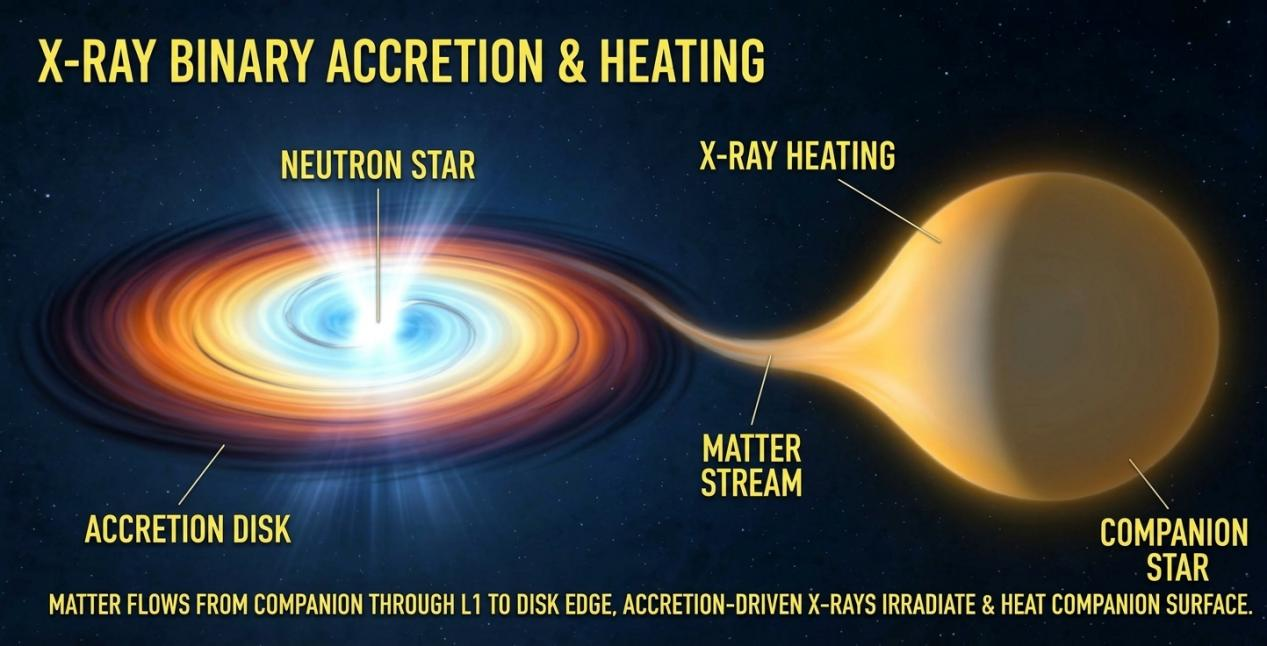
Figure 1: Schematic of a low-mass X-ray binary. Image generated by AI.
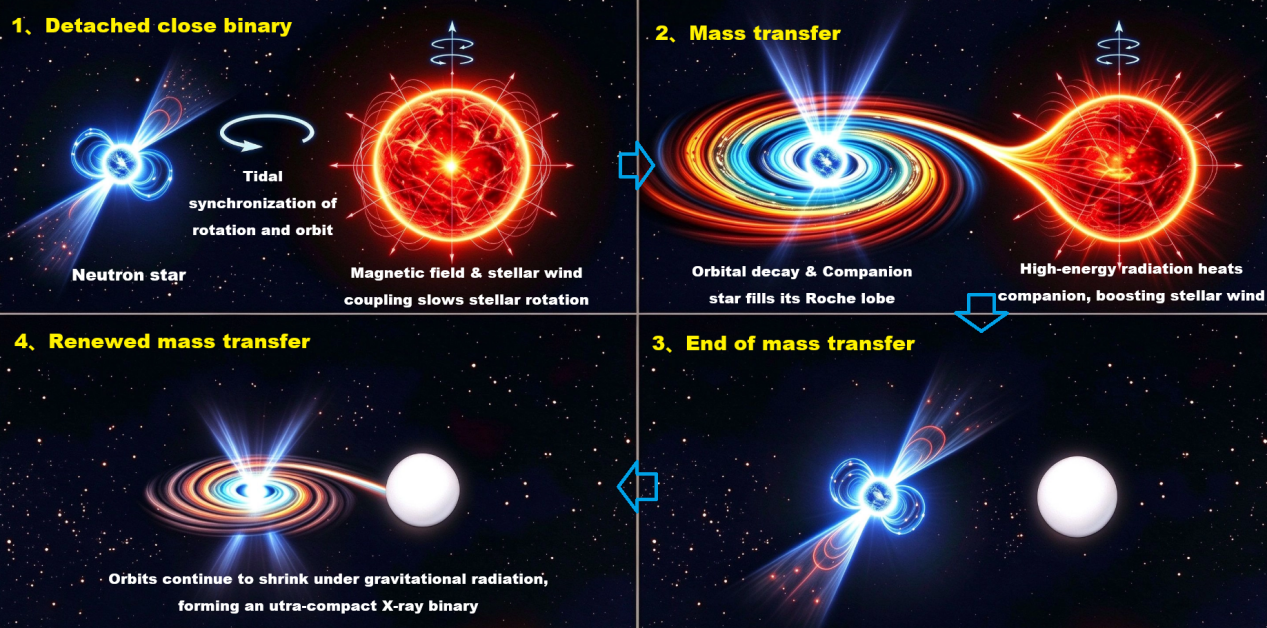
Figure 2: Complete schematic showing how magnetic stellar-wind braking, combined with irradiation feedback that enhances the stellar wind, affects the evolution of low-mass X-ray binaries. Image generated by AI.
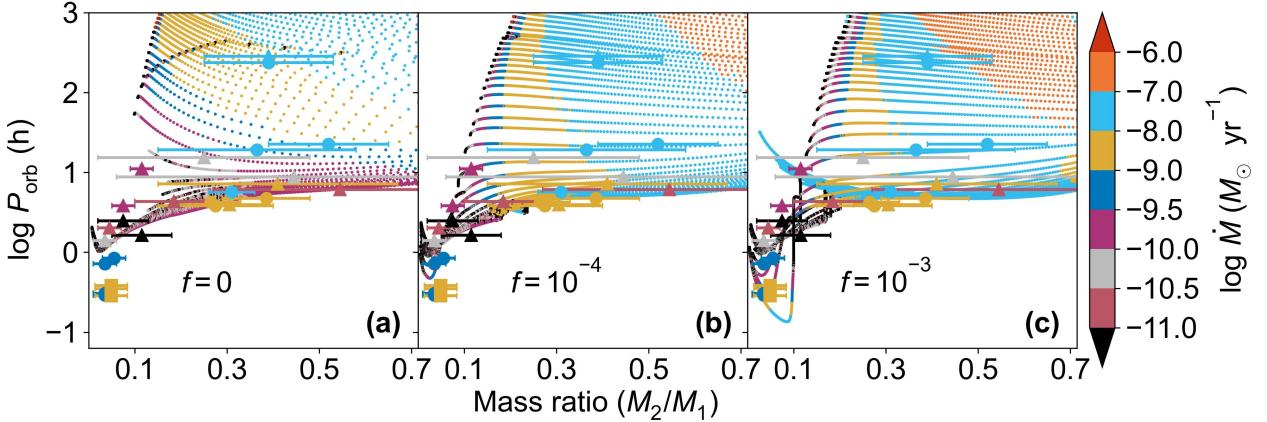
Figure 3: Evolution of low-mass X-ray binaries under different irradiation efficiencies. Triangles and circles represent transients and persistent sources, respectively; squares indicate systems in globular clusters. Different colors represent different accretion-rate ranges. Image by DENG.
Contact:
DENG Zhuling
Yunnan Observatories, CAS
e-mail:dengzl2021@163.com


