Recently, Associate Researcher JIAO Chengliang and Assistant Researcher ZHAO Ergang of Yunnan Observatories, Chinese Academy of Sciences, together with their collaborators, published a research article in The Astrophysical Journal. The study shows that the long photometric cycles observed in double-periodic variables (DPVs) may originate from tidally driven nodal precession of a tilted accretion disk. This work provides a quantitative framework for interpreting the long-cycle variability in these systems and offers a promising new mechanism for understanding their photometric behavior.
Double-periodic variables (DPVs) are interacting binary systems exhibiting both orbital variability and a much longer photometric cycle (typically Plong/Porb≈33). They were first identified in surveys of the Magellanic Clouds and have since been widely detected in the Milky Way. Although more than 200 systems have been reported, the physical origin of the long-cycle variability remains uncertain. Previous studies have broadly attributed the long-cycle variability to cyclic variations in mass transfer or in accretion-related processes, including donor-star magnetic activity, structural changes in the accretion disk, winds or episodic mass loss, and variable circumstellar or circumbinary material. However, a consistent and testable quantitative framework has remained lacking.
In this work, the researchers developed an analytical framework describing the nodal precession of a tilted accretion disk driven by tidal torques from the companion star. The model establishes quantitative relations linking the long-to-orbital period ratio to key system parameters, including the binary mass ratio, the relative disk size, and the disk tilt angle. In addition, the disk tilt angle can be independently constrained from observable quantities such as the long-cycle photometric amplitude, the orbital inclination, and the fractional contribution of the disk to the total luminosity. The study shows that geometric projection effects naturally reproduce two observed DPV light-curve morphologies: sinusoidal variations when the sum of the orbital inclination (i) and the disk tilt angle (β) satisfies i + β ≤ 90°, and double-hump structures when i + β > 90°.
Applying the model to a sample of 13 DPVs, the researchers find that the inferred disk sizes are physically reasonable and consistent with independent observational estimates for a substantial fraction of systems. This suggests that tidal nodal precession is an important contributor to long-period variability in DPVs.
The study offers a new perspective on the dynamical behavior of accretion disks in interacting binaries and provides a quantitative framework for future observational and theoretical studies.
This research was supported by the Chinese Academy of Sciences Grand Challenges Program, the Yunnan Province Special Fund for Construction of the South and Southeast Asia-Oriented Center for Technological Innovation, the Yunnan Province Key Project Fund, and the Yunnan Revitalization Talent Support Program.
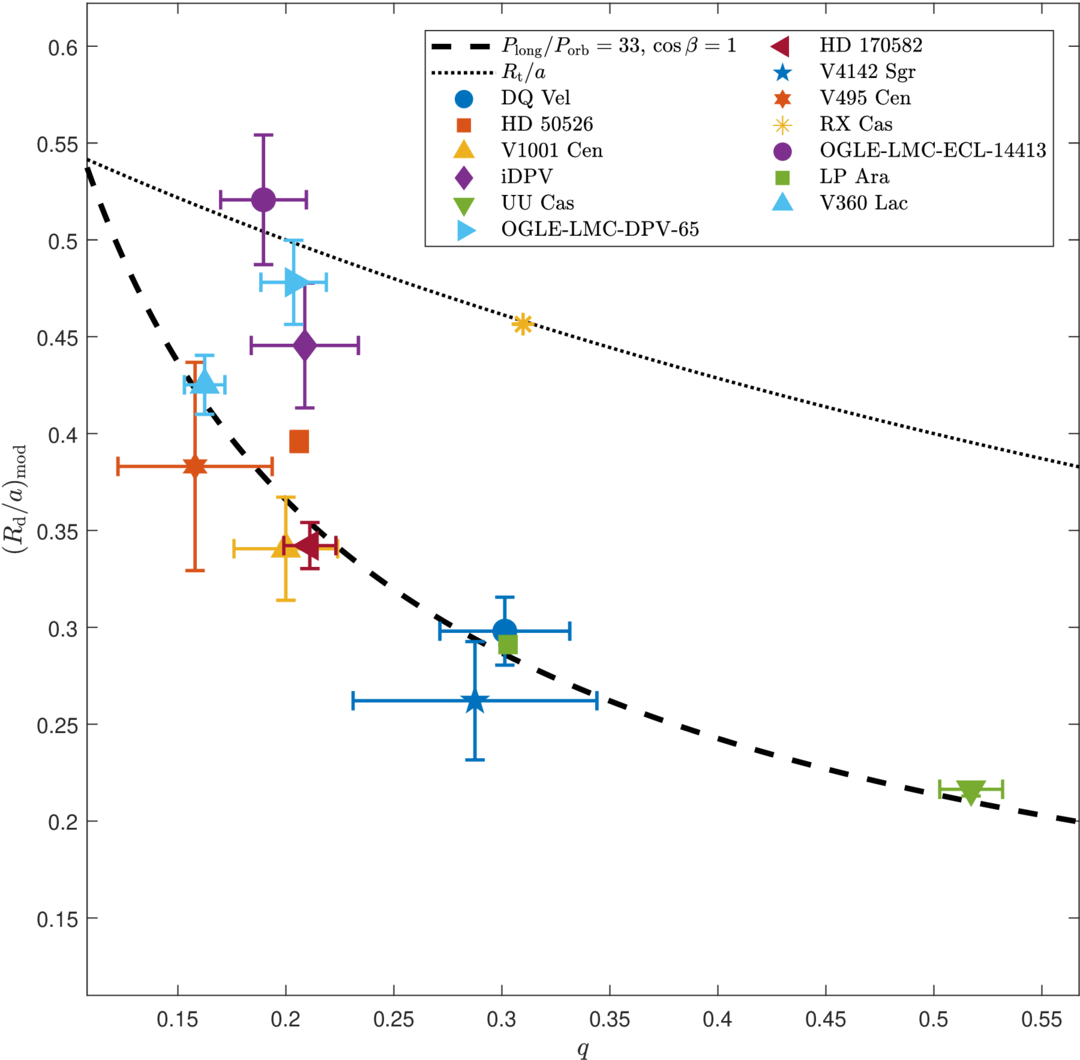
Figure 1. Model-predicted disk radius as a function of mass ratio q for 13 DPV systems. Image by JIAO.
Contact:
JIAO Chengliang
Yunnan Observatories, CAS
e-mail:jiaocl@ynao.ac.cn


