Dr. GUO Yanjun and collaborators from the Yunnan Observatories of the Chinese Academy of Sciences, the National Astronomical Observatories, and the Hebei Normal University, recently have published a study on the origin of B-type runaway stars based on kinematics in the Astronomy & Astrophysics. This study performed orbital traceback analyses for a sample of 39 B-type runaway stars and revealed a correspondence between the traced-back trajectories and the two formation channels, providing new observational evidence to constrain the origins of B-type runaways.
Runaway stars are featured by their high peculiar velocities, typically exceeding 30-40 km/s. Two distinct mechanisms have been proposed to explain their origin: the dynamical ejection scenario (DES), in which stars are ejected through close dynamical encounters in dense stellar systems, and the binary-supernova scenario (BSS), in which a star is released from a close binary after its companion explodes as a supernova. Runaway stars of DES and BSS origin can be distinguished by tracing their orbits back to clusters, by examining chemical signatures, and by comparing their kinematics. DES runaways generally have higher space velocities, whereas stars with high projected rotational speeds (v sin i) are thought to arise mainly from BSS.
In this study, the team selected 39 B-type runaway stars from the Large Sky Area Multi-Object Fiber Spectroscopic Telescope (LAMOST) catalog. They determined spectral subtypes from key absorption lines and derived atmospheric parameters using the Stellar Label Machine (SLAM), which was trained on TLUSTY synthetic spectra computed under the non-local thermodynamic equilibrium (NLTE) assumption. These atmospheric parameters was then used to estimate stellar masses and ages with a machine learning model trained on PAdova and TRieste Stellar Evolution Code (PARSEC) evolutionary tracks. Finally, orbital traceback analysis was performed with Galactic Dynamics PYthon Library (GALPY).
The analysis revealed that 29 stars have trajectories entirely within the Galactic disk, whereas 10 are disk-passing yet still trace back to the disk. Two stars have trajectories that intersect those of known clusters. Additionally, data in the peculiar space velocities (Vsp) versus projected rotational velocity (vsini) plane suggest that runaway stars with low peculiar space velocities but high vsini remain on the Galactic disk, whereas those with high peculiar space velocities but low vsini pass through the disk, possibly reflecting two distinct origins.
"This research may provide new kinematic evidence to distinguish between the binary supernova and dynamical ejection scenarios. However, our conclusions are limited by the lack of high-resolution spectroscopic abundances." GUO Yanjun said, "Future surveys with higher precision spectroscopy will be crucial to establish firmer constraints on the origins of runaway stars and their role in binary evolution and cluster dynamics."
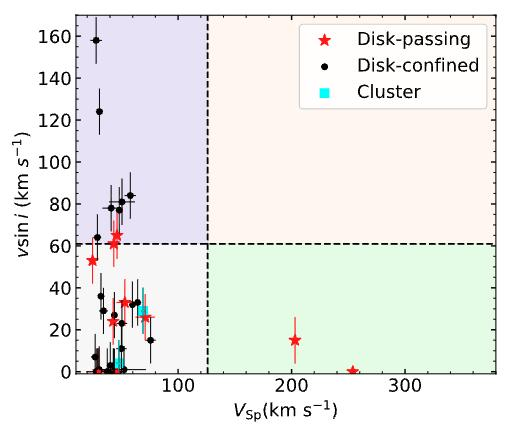
Figure 1, distribution of peculiar space velocities and projected rotational velocities. Image by GUO.
Contact:
GUO Yanjun
Yunnan Observatories, CAS
e-mail:guoyanjun@ynao.ac.cn


