A study led by SHEN Yuheng, a master's student at the Southern Astronomical Observatory of the Yunnan Observatories of the Chinese Academy of Sciences, and his supervisor LU Kaixing, along with others, has provided new statistical evidence on the behavior of "changing-look" active galactic nuclei (CL-AGNs). By analyzing two-epoch spectra of 203 such objects, the team has statistically confirmed that the variation in the accretion rate of black holes directly regulates the ionizing flux in the broad-line region, thereby triggering a complete spectral transition from type 1.0 to 2.0 in AGN. The research was published in the Astrophysical Journal.
This research reveals that the spectral evolution of AGN is universally related to the accretion process of supermassive black holes and achieves a parametric description of spectral type transitions through regression analysis. This finding challenges the unified model that solely relies on the viewing angle effect and explicitly incorporates the historical evolution of the accretion process into the core considerations of the AGN classification.
Over 1.5 million AGN have been observed and are known to exist across various cosmic epochs, making them important probes for studying universe structure and evolution. While the unified model attributes AGN types to viewing angles, and their energy to the accretion process of supermassive black holes at the center of galaxies, the discovery of CL-AGNs has presented a challenge.These object exhibit extreme changes, with broad emission lines appearing or disappearing over years to decades, a phenomenon not explained by static models.
To investigate, the research team used data from the Sloan Digital Sky Survey (SDSS DR16) and the Dark Energy Spectroscopic Instrument (DESI DR1).They selected a sample of 203 CL-AGNs with redshifts below 0.35, ensuring coverage of both Hα and Hβ broad emission lines. Through precise spectral fitting and parameter measurement, the sample was divided into two categories: Data Set A (containing 110 sources), showing only minor spectral type fluctuations, possibly reflecting the variability of normal AGNs; Data Set B (containing 93 sources), showing significant "on-off" behavior characteristic of typical CL-AGNs.
Bayesian linear regression analysis revealed two core correlations: the spectral type change of AGN is positively correlated with both the Hα broad emission line luminosity and the Eddington ratio (the ratio of bolometric luminosity to Eddington luminosity).This relationship was more obvious in Data Set B. The correlations indicate that as the accretion rate increases, the ionizing photon flux in the broad-line region strengthens, transformingan AGN from type 2.0 (broad lines absent) to type 1.0 (broad lines significant). The reverse process occurs as the accretion rate decreases.
The study suggests that CL-AGN behavior is closely related to the structure of the accretion flow. For instance, when the accretion rate falls below a critical value (with an Eddington ratio near 0.02), a standard thin disk may transition to a radiation dominated accretion flow (ADAF), causing a sharp decline in ionizing radiation. While previous case studies of Mrk 1018 observed a complete cycle transition from type 2.0 to 1.0 accompanied by changes in the accretion rate (Eddington ratio rising from 2×10⁻⁵ to 0.02) , this sample analysis further verifies the universality of this mechanism.
"The accretion process of black holes is like the 'heartbeat' of AGN," said corresponding author LU Kaixing. "Its fluctuations are sufficient to change the entire system's observable characteristics. The series of works related to this research have, for the first time, through sample statistics and individual case tracking, discovered that the optical observation features such as the type transformation of AGN is directly related to the accretion physics. In the future, it is necessary to combine multi-wavelength data to further explore the coordinated evolution laws among the various components of active galactic nuclei and reveal the essence of AGN."
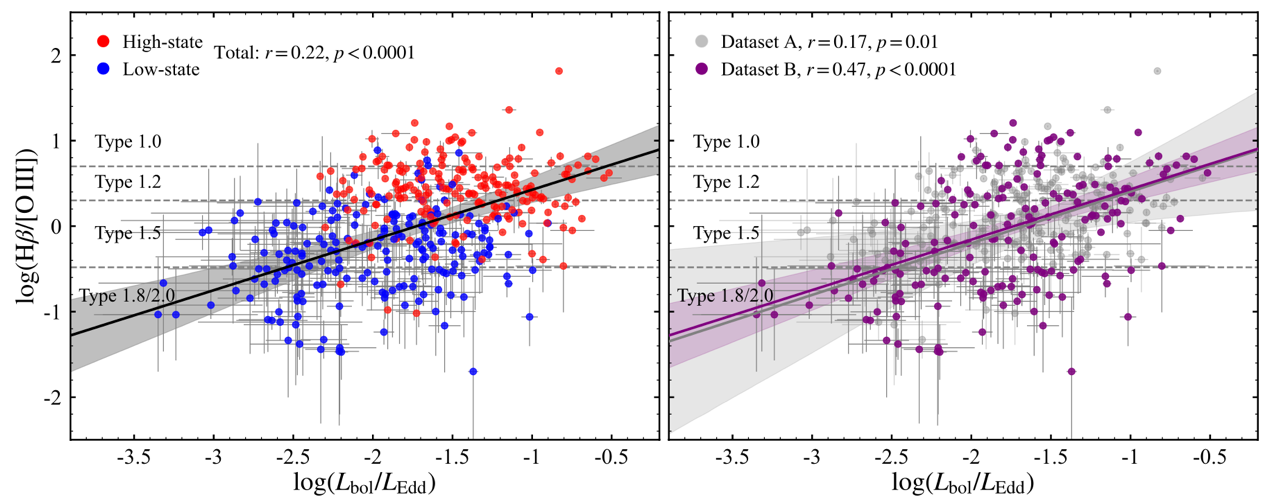
Figure 1: the positive correlation between the spectral type variation of AGN and the Eddington ratio, as well as the analysis results. The left figure defines the bright state and the dim state of AGN with red and blue dots respectively, while the right figure distinguishes the cases of weak spectral type fluctuation (Data Set A) and significant "on-off" dramatic change (Data Set B). Image by LU Kaixing.
Contact:
LU Kaixing
Yunnan Observatories, CAS
e-mail:lukx@ynao.ac.cn


