Recently, PhD student DONG Qifan, Professor YAN Xiaoli, and their collaborators from the Fuxian Lake Solar Observatory of the Yunnan Observatories, Chinese Academy of Sciences, conducted a systematic investigation of transverse oscillations and associated energy transport in solar chromospheric fibrils using high-resolution observations from the 4-meter Daniel K. Inouye Solar Telescope (DKIST). The research results were published in The Astrophysical Journal.
Chromospheric fibrils are ubiquitous, elongated structures in the solar chromosphere that generally extend along magnetic field lines. They serve as important waveguides for investigating magnetohydrodynamic wave propagation and energy transport in the solar atmosphere. Understanding transverse oscillations in these structures is essential for exploring the heating mechanisms of the solar chromosphere and corona. However, due to the limited spatial and temporal resolution of previous observations, high-frequency transverse oscillations with small displacement amplitudes have not been resolved. Their statistical properties and contributions to energy transport are insufficiently characterized.
The research team utilized high-resolution Hα observations of the quiet-Sun and active region obtained by the Visible Broadband Imager (VBI) onboard DKIST on August 29, 2023, and August 27, 2024, respectively. By employing the Automatic Northumbria University Wave Tracking algorithm (Auto-NUWT), the team systematically analyzed the transverse oscillations of chromospheric fibrils.
A total of 22,866 oscillation measurements were obtained, revealing that high-frequency, small-amplitude transverse oscillations were highly prevalent in fibrils across different magnetic environments. The detected oscillations exhibited a mean period of approximately 56 ± 49 s, a displacement amplitude of 37 ± 25 km, and a velocity amplitude of 6 ± 4 km s⁻¹.
Furthermore, by comparing oscillation signals at adjacent positions along the fibrils, the researchers obtained 3,244 reliable measurements of propagating waves, with a characteristic phase speed of approximately 21 ± 13 km s⁻¹. These oscillation characteristics were consistent with Alfvénic kink-mode waves. Based on the wave parameters, the estimated energy flux carried by the detected transverse kink waves was approximately 20 to 200 W m⁻².
This study reveals a widespread population of high-frequency, small-amplitude transverse waves in solar chromospheric fibrils that has not been sufficiently characterized in previous statistical investigations. Compared with the oscillation periods reported in earlier observations, the substantially shorter periods identified in this study suggest that previous observations may have missed a significant population of small-amplitude, high-frequency waves.
Although the estimated wave energy flux is insufficient to sustain chromospheric heating on its own, these findings provide new observational constraints on magnetohydrodynamic wave propagation and energy transport in the solar chromosphere. Moreover, the results highlight the unprecedented capabilities of DKIST in resolving fine-scale structures and rapid dynamical processes in the solar atmosphere.
This work is supported by the Strategic Priority Research Program of the Chinese Academy of Sciences; the National Key R&D Program of China; the National Science Foundation of China (NSFC); Yunnan Key Laboratory of Solar Physics and Space Science; the Yunnan Science Foundation of China; the Yunnan Province Xing Dian Talent Support Program, the Yunling Scholar Project, and Yunnan Revitalization Talent Support Program.
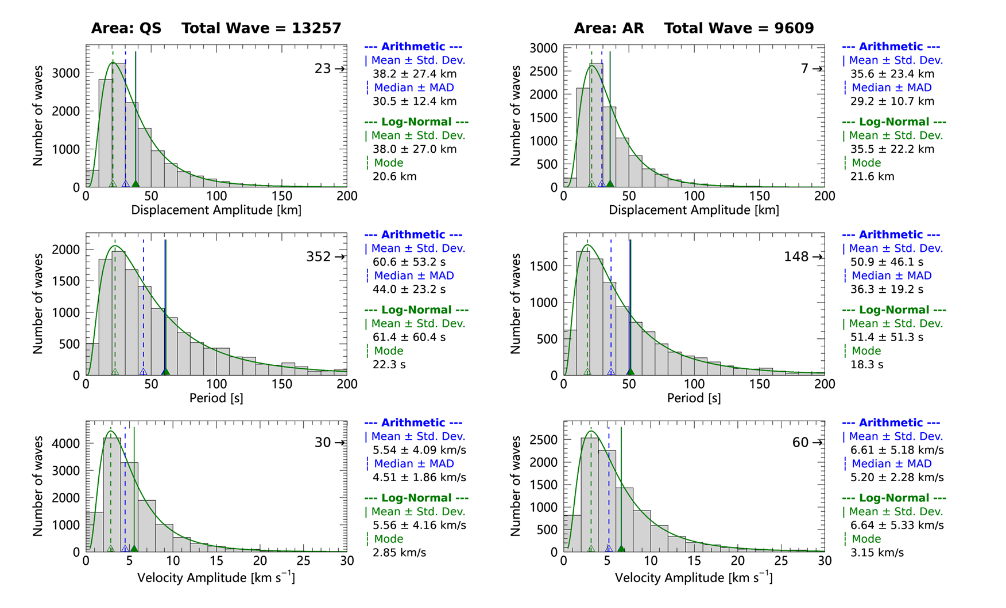
Figure 1. Statistical distributions of transverse oscillation properties in chromospheric fibrils observed in quiet-Sun (left column) and active-region (right column). From top to bottom, the panels show the distributions of displacement amplitude, period, and velocity amplitude, respectively. The green curves represent log-normal fits to the observed distributions. Image by DONG.
Contact:
YAN Xiaoli
Yunnan Observatories, CAS
e-mail:yanxl@ynao.ac.cn


