Recently, SHI Yanxu (PhD candidate), Prof. GE Hongwei and their collaborators from Yunnan Observatories, Chinese Academy of Sciences (CAS), in partnership with researchers from the Universitat Politècnica de Catalunya, Spain, have reported new findings in binary stellar evolution. Using a physically motivated mass-transfer stability criterion, the team improved the binary population synthesis model and systematically uncovered, for the first time, the key regulatory effect of mass-transfer stability on the post-common-envelope binary (PCEB) population. This work offers a new interpretation for the long-standing academic puzzle: the observed scarcity of PCEBs with solar-type main-sequence (MS) companions. The findings have been published in The Astrophysical Journal.
More than half of the stars in the Universe are members of binary systems. Binary interactions serve as the core driver for the formation of a wide range of exotic astronomical objects, including compact stars and transient sources. Among these interaction processes, common-envelope (CE) evolution is a critical stage in the formation of short-period compact binaries, and remains one of the most uncertain and debated physical processes in stellar evolution theory. As the direct evolutionary outcome of CE evolution, PCEBs are widely recognized as "natural laboratories" for testing CE evolution theory and ideal samples for placing quantitative constraints on CE physics.
Observational census to date shows that the known PCEB population is dominated by systems with low-mass M dwarf companions, whereas systems hosting solar-type (A/F/G/K-type) MS companions are markedly underrepresented. Conventional binary population synthesis models, which employ mass-transfer stability criteria based on polytropic stellar models, systematically overpredict the count of such solar-type companion PCEBs, resulting in a pronounced discrepancy with observations. Historically, this observed deficit was commonly ascribed to magnetic braking mechanisms and observational selection effects, but this explanation long lacked thorough theoretical validation.
In this study, the research team adopted the rapid binary evolution code (BSE), incorporated the mass-transfer stability criterion derived from the adiabatic mass-loss model, and updated the binary population synthesis framework with a self-consistent envelope binding-energy prescription. The results show that the critical mass ratio predicted by the new criterion is substantially higher than that of the traditional polytropic model. This makes binary systems with comparable primary and secondary masses much less likely to enter the CE phase, thus greatly reducing the expected number of PCEBs with solar-type main-sequence companions at the formation channel level. The study confirms that neither strengthened magnetic braking nor observational selection effects alone can fully account for the observed deficit. Instead, the combination of enhanced mass-transfer stability, magnetic braking and selection effects presents the most physically plausible scenario.
This work systematically demonstrates the central role of realistic mass-transfer stability criteria in interpreting the observed PCEB population. It provides new quantitative constraints on CE evolution physics, and carries important guiding significance for studies of the formation and evolution of compact binary populations, including cataclysmic variables, AM CVn binaries and double white dwarfs.
This research was supported by the National Natural Science Foundation of China, the Chinese Academy of Sciences, and the Natural Science Foundation of Yunnan Province.
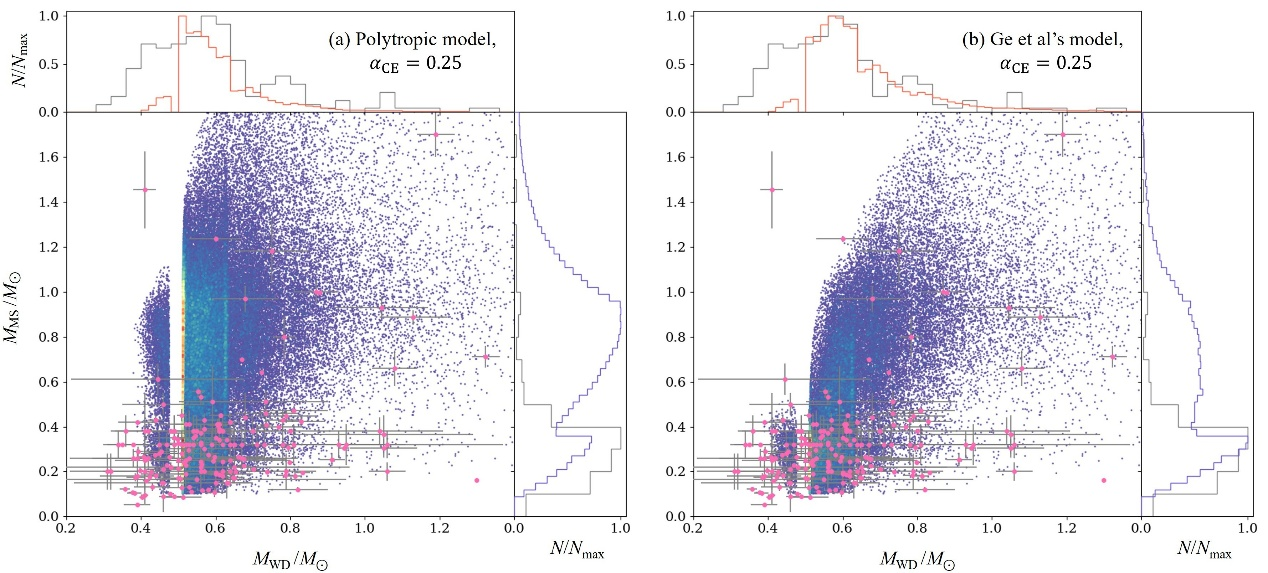
Figure 1. Distribution of PCEBs in the MWD–MMS plane predicted by the polytropic model (a) and the adiabatic mass-loss model (b). Image by SHI.
Contact:
SHI Yanxu
Yunnan Observatories, CAS
e-mail:shiyanxu@ynao.ac.cn


