Recently, PhD student LI Ruijie and Prof. WANG Bo from Yunnan Observatories, Chinese Academy of Sciences, reported new findings on dwarf novae. The team found that cyclic accretion in dwarf novae cannot sustain stable hydrogen burning on white dwarfs. Recurrent nova eruptions reduce the mass retention efficiency of white dwarfs, preventing them from growing to the Chandrasekhar mass limit through long-term accretion. Therefore, dwarf novae are unlikely to be progenitor systems of Type Ia supernovae. The study has been published in the international astronomical journal Astronomy & Astrophysics.
Dwarf novae usually consist of a carbon–oxygen white dwarf and a low-mass companion star. Due to the thermal-viscous instability of the accretion disk, these systems undergo periodic outbursts. During outbursts, the accretion rate onto the white dwarf increases significantly. Therefore, dwarf novae have been proposed as possible systems in which white dwarfs could gradually gain mass through long-term accretion and eventually reach the Chandrasekhar mass limit, triggering Type Ia supernova explosions.
The research team constructed periodic accretion models of carbon–oxygen white dwarfs to simulate the long-term “outburst–quiescence” cycles of dwarf novae. They found that although the high accretion rate during outbursts can reach the stable hydrogen-burning regime, the white dwarf continuously cools during the prolonged quiescent phases. As the degree of degeneracy increases, the accreted material eventually undergoes a thermonuclear runaway on the white dwarf surface, leading to nova eruptions rather than stable hydrogen burning.
Further investigations showed that strong stellar winds produced during nova eruptions eject a large amount of accreted material, preventing the white dwarf from efficiently retaining mass. With repeated outburst cycles, the mass retention efficiency of the white dwarf gradually decreases. Even when varying accretion parameters, such as the initial white dwarf temperature, accretion rate, outburst duration, and rotation, periodic accretion cannot drive the white dwarf to continuously grow toward the Chandrasekhar mass limit. The study showed that the outburst–quiescence cycles in dwarf novae lead to nova eruptions and limit long-term white dwarf mass growth, providing new insights into the possibility of dwarf novae as Type Ia supernova progenitor systems.
This work was supported by the National Natural Science Foundation of China, the Yunnan Supernova Research Innovation Team, the International Centre of Supernovae, Yunnan Key Laboratory (ICESUN), and the Xingdian Talent Support Program (Yunling Scholar Special Project).
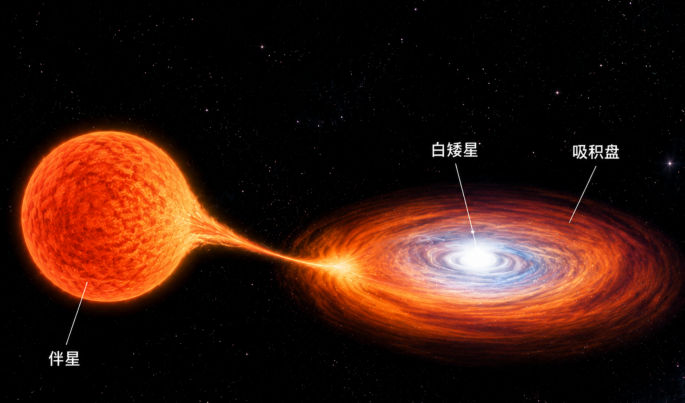
Figure 1: Schematic illustration of a dwarf nova outburst (AI-generated image).
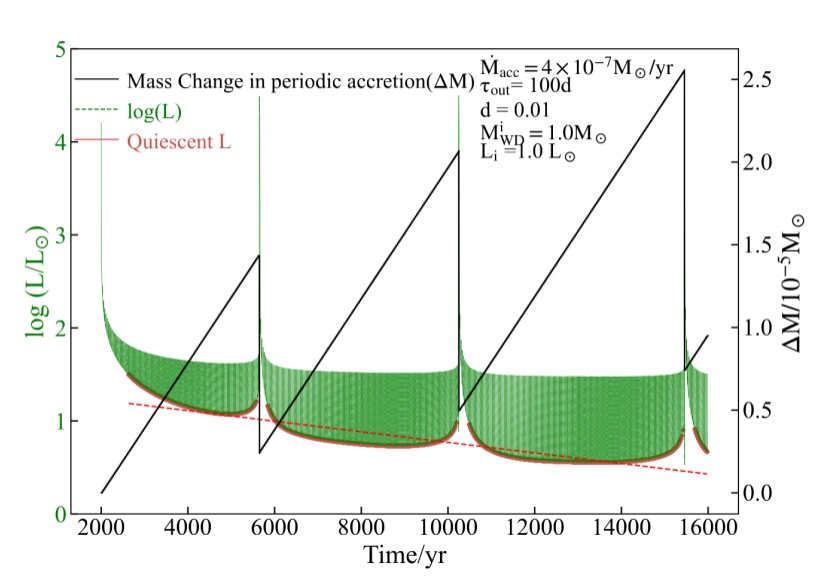
Figure 2: Evolution of the white dwarf mass and luminosity during cyclic accretion. Image by LI.
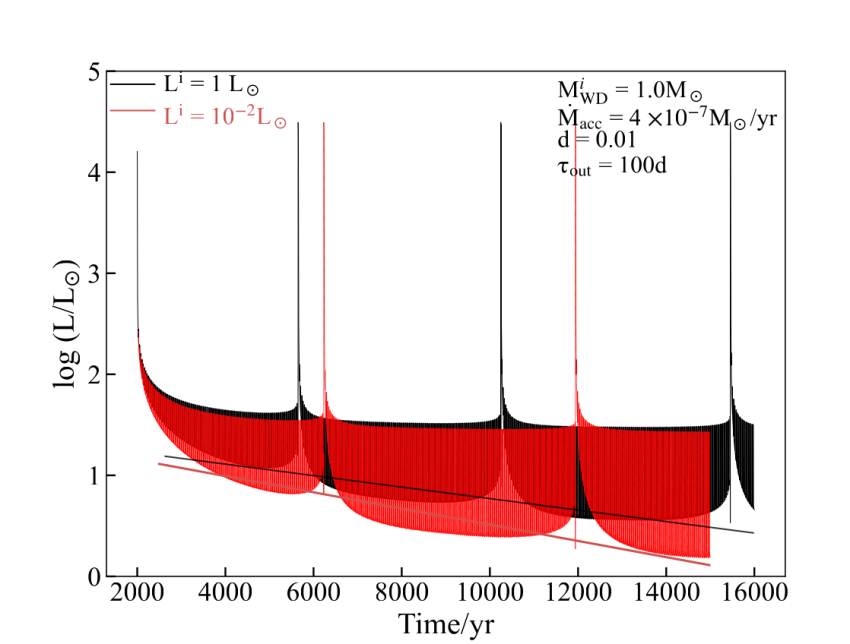
Figure 3: Comparison of luminosity evolution for white dwarfs with different initial temperatures during cyclic accretion.
Contact:
LI Ruijie
Yunnan Observatories, CAS
e-mail:liruijie@ynao.ac.cn


