A research team led by Dr. ZHAI Qian of Yunnan Observatories, Chinese Academy of Sciences, has reported new observational constraints on the rare and luminous Type Ia supernova SN 2022erq. The researchers found that the mass-loss rate of its progenitor system rose sharply during the final decades before the explosion, increasing by about an order of magnitude as the system approached explosion. This finding provides observational evidence for understanding the final evolution of Type Ia supernova progenitor systems. The study has been published in The Astrophysical Journal.
SN 2022erq was discovered by the Asteroid Terrestrial-impact Last Alert System (ATLAS). Shortly thereafter, the research team conducted spectroscopic observations with the Lijiang 2.4 m Telescope at Yunnan Observatories and identified it as an SN Ia-CSM — a Type Ia supernova undergoing strong interaction with circumstellar material (CSM). Such events are extremely rare, accounting for only about 0.1% of all Type Ia supernovae.
Following the identification, the team coordinated observations with multiple telescopes worldwide and continuously monitored SN 2022erq for three years. Based on a comprehensive analysis of the spectroscopic and photometric data, the researchers reconstructed the mass-loss history of the progenitor system before the explosion. About 60 years before the explosion, the system was ejecting material at a rate of approximately 0.04 solar masses per year. In the final few years before the explosion, the mass-loss rate soared to about 0.6 solar masses per year. The expelled material accumulated into a massive gas shell with a total mass of about three solar masses, extending outward to approximately 350 billion kilometers.
This finding challenges existing theoretical models of Type Ia supernova progenitors. Although current mainstream models can produce modest amounts of circumstellar material, they struggle to simultaneously explain both the enormous CSM mass and the extreme mass-loss rate exhibited by SN 2022erq. The researchers suggest that the progenitor was likely a close binary system consisting of a white dwarf and an intermediate-mass non-degenerate companion. Shortly before the explosion, the system may have undergone a brief and violent evolutionary phase — such as common-envelope evolution with intense mass transfer, or the rapid merger of the white dwarf with the core of a giant companion. Such strong binary interaction could naturally account for the sharp increase in mass loss shortly before the explosion. The unusual physical conditions required may also explain why SNe Ia-CSM are so rare.
The study of SN 2022erq not only provides a high-quality observational benchmark for this rare class of supernovae, but also establishes clear quantitative constraints for theoretical models: what binary evolutionary pathway can eject several solar masses of material within only decades before a thermonuclear explosion? Answering this question will deepen our understanding of the nature of Type Ia supernova progenitors and the violent processes that binary systems may experience in their final evolutionary stages before explosion.
The study used observations from more than a dozen telescopes worldwide, including the Lijiang 2.4 m Telescope and the Daocheng Wumingshan 60 cm Telescope of Yunnan Observatories; the Xinglong 2.16 m Telescope and the Tsinghua-NAOC 80 cm Telescope of the National Astronomical Observatories; the Italian 3.58 m Telescopio Nazionale Galileo; the 2.56 m Nordic Optical Telescope; the Liverpool 2.0 m Telescope; the Hungarian Konkoly Observatory 80 cm RC Telescope; the 10 m Keck II Telescope and the 9.2 m Hobby-Eberly Telescope in the United States; the 4.2 m William Herschel Telescope; and the 67/91 cm Schmidt Telescope.
This work was supported by the National Key Research and Development Program of China, the Strategic Priority Research Program of the Chinese Academy of Sciences, the National Natural Science Foundation of China, the Yunnan Provincial Science and Technology Projects, the Yunnan "Xingdian Talents" Program, and the International Centre of Supernovae (ICESUN).
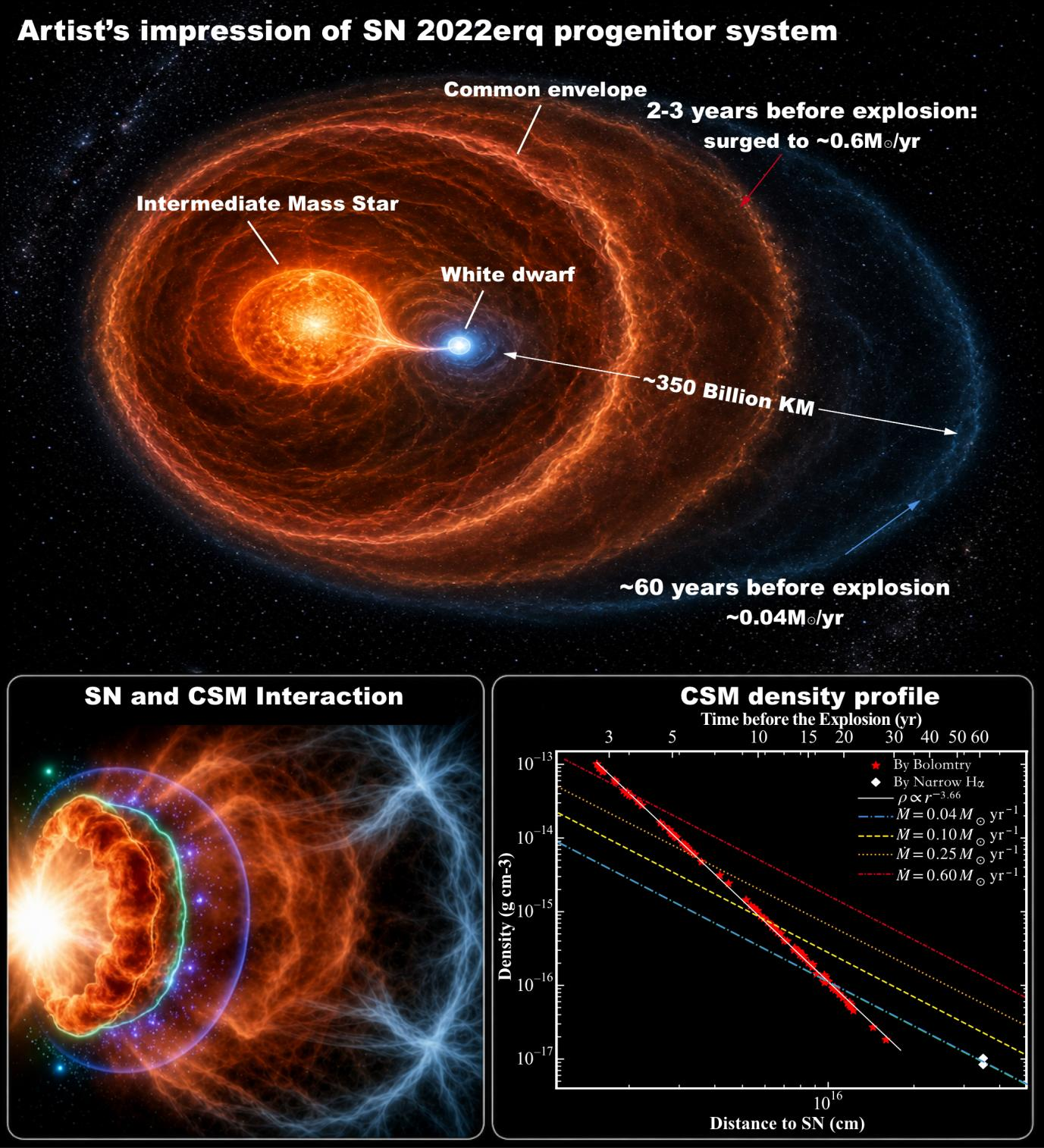
Figure 1:Schematic illustration of the progenitor system, circumstellar environment, and post-explosion interaction of SN 2022erq. The top panel shows an artist’s impression of the progenitor system; the lower-left panel illustrates the SN-CSM interaction; and the lower-right panel presents the measured CSM density profile. Image by ZHAI.
Contact:
ZHAI Qian
Yunnan Observatories, CAS
e-mail:zhaiqian@ynao.ac.cn


