Recently, a research team led by PhD candidate DONG Qifan and supervisor Prof. YAN Xiaoli from the Fuxian Lake Solar Observatory of the Yunnan Observatories, Chinese Academy of Sciences (CAS), used high-resolution observational data from the 4 m Daniel K. Inouye Solar Telescope (DKIST) to investigate the formation mechanism of spicules in the solar chromosphere. The team found that these spicules are triggered by microfilament eruptions. The findings were published in The Astrophysical Journal Letters.
Solar spicules are ubiquitous, dynamic, small-scale jet in the chromosphere, appearing as plasma protrusions ejected from the magnetic network. Understanding their formation mechanism is important for clarifying how mass and energy are transported from the lower solar atmosphere into the corona.
The researcher analyzed 30 spicule events associated with microfilament eruptions, using high spatio-temporal resolution Hα data of the quiet-Sun disk center obtained on August 29, 2023, by the Visible Broadband Imager on board DKIST. The microfilaments had an average length of only 0.93 ± 0.46 Mm, with the minimum length being a mere 0.17 Mm. This scale is notably smaller than the minifilaments reported in previous study.
The team also identified two distinct spicule morphologies: individual spicules associated with smaller microfilaments, and enhanced spicular activities associated with larger microfilaments. Furthermore, some spicules exhibit apparent twisting motions, which is similar to the kinematic characteristics of coronal jets. The total energy released by a single microfilament eruption is estimated at approximately 0.15 × 1024 erg. Extrapolated to the entire solar chromosphere, the number of such eruptions occurring at any given moment is about 2.4 × 10⁴.
This research provides strong empirical support for the model in which spicules are driven by microfilament eruptions. The study reveals a correlation between the spatial scale of microfilaments and the morphology of the resulting spicules, and further confirms that solar eruptive activities across different spatial scales are governed by common physical mechanisms. The results also validate the high-resolution capabilities of DKIST in observing fine chromospheric structures, and lay a reliable foundation for defining the scientific objectives of China’s Giant Solar Telescope.
This work is supported by the Strategic Priority Research Program of the Chinese Academy of Sciences; the National Science Foundation of China (NSFC); Yunnan Key Laboratory of Solar Physics and Space Science; the Yunnan Science Foundation of China; the Yunnan Province Xing Dian Talent Support Program, the Yunling Scholar Project, and Yunnan Revitalization Talent Support Program.
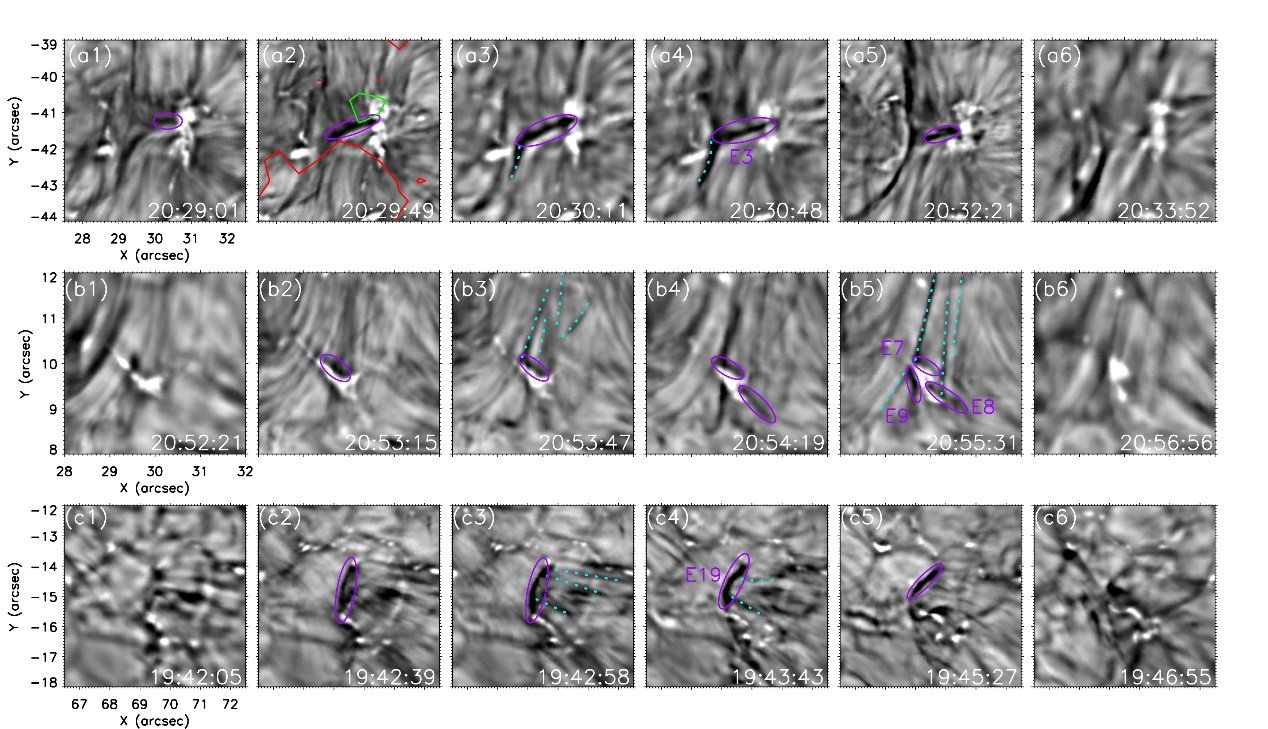
Figure 1: Evolution of five microfilament eruptions. The locations of the microfilaments are marked by purple ellipses, and the spicules produced by the eruptions are denoted by cyan dotted lines. In panel (a2), the red contour represents +12 G and the green contour represents −12 G. Image by DONG.
Contact:
YAN Xiaoli
Yunnan Observatories, CAS
e-mail:yanxl@ynao.ac.cn


