A research team from the Astronomical Technology Laboratory at the Yunnan Observatories, Chinese Academy of Sciences, has developed a method to separate chromospheric and photospheric signals in high-resolution He I (10830 Å) observations from the New Vacuum Solar Telescope (NVST) at Fuxian Lake. The study, which addresses a key bottleneck in the quantitative analysis of chromospheric information from this line, was published in The Astrophysical Journal Supplement Series.
The He I (10830 Å) line acts as an important link between the photosphere and the high-temperature corona, making high-resolution imaging of this line a valuable tool for studying energy transport between these layers. Using an in-house near-infrared detector and a Lyot filter developed by the Nanjing Institute of Astronomical Optics & Technology, the NVST obtains high-resolution He I (10830 Å) images. However, because the line is optically thin and the Lyot filter has a 0.5 Å band width, a substantial photospheric background persists in the images. This contamination presents a challenge for quantitative analysis of chromospheric fine structures. To isolate the chromospheric features, the team trained a ResNet-based deep convolutional neural network that uses cross-band photospheric information to infer the photospheric component within the He I (10830 Å) imaging data. By training the model with simultaneous high-resolution photospheric images at 7058 Å, the researchers recovered the photospheric signals in the He I (10830 Å) data and then extracted pure chromospheric information through an exponential absorption model.
The team conducted a pixel-level correlation analysis between the extracted chromospheric information from the NVST He I (10830 Å) line imaging and the Extreme Ultraviolet (EUV) imaging data from the Atmospheric Imaging Assembly (AIA) onboard the Solar Dynamics Observatory (SDO). The correlation analysis based on the integrated data over a 45-minute period revealed a significant negative intensity correlation between the He I (10830 Å) chromosphere and the AIA EUV bands in the quiet Sun region. Specifically, the correlation coefficients with the 304 Å, 171 Å, and 193 Å bands reached -0.84, -0.78, and -0.66, respectively, compared with -0.72, -0.68, and -0.56 before separation.
These results demonstrates that the method developed by the team to extract chromospheric information from He I (10830 Å) observations has laid a solid foundation for the quantitative analysis and study of chromospheric fine structures in the NVST He I (10830 Å) line.
This research was partially supported by National Key R&D Program of China, the National Natural Science Foundation of China, and the Key Laboratory of Solar Physics and Space Object Survey of Yunnan Province.
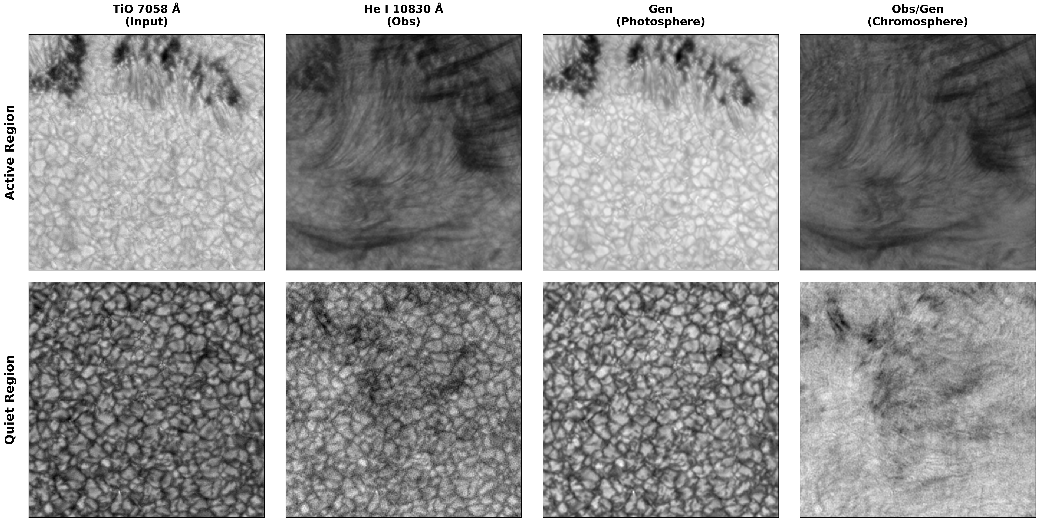
Figure 1. Top row: Active region data; bottom row: quiet Sun region data. First column: TiO; second column: observed He I (10830 Å) signals; third column: model-generated photospheric signals within the observed He I (10830 Å) signals; fourth column: extracted chromospheric signals separated from the observed signals. Image by LI.
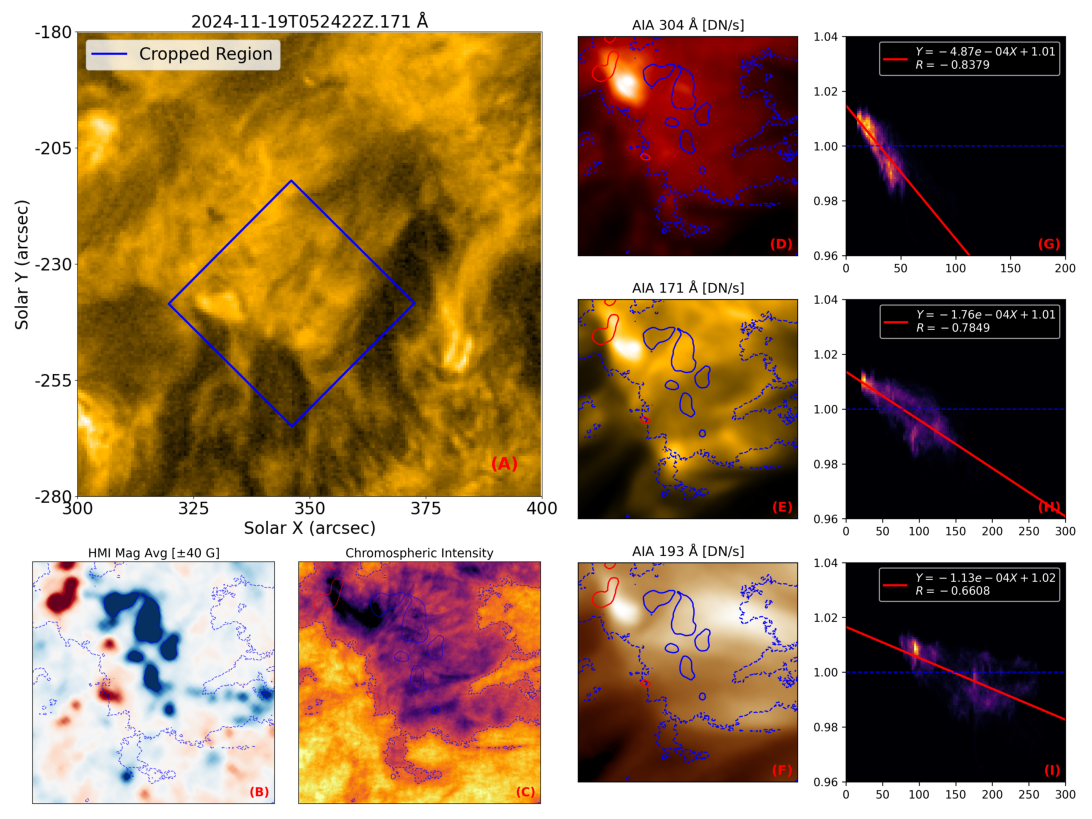
Figure 2. (A) SDO/AIA 171 Å image, with the blue box denoting the study region of this work. (B) 45-minute time-averaged line-of-sight (LOS) magnetogram from HMI. (C) Time-averaged chromospheric signals in the He I (10830 Å) line. (D)–(F) Time-averaged observation data of the 171 Å, 193 Å, and 304 Å bands within the study region. (G)–(I) Scatter plots and their linear fitting relationships, where the x-axis represents the intensities of the three AIA bands (171 Å, 193 Å, and 304 Å) and the y-axis represents the intensity of the He I (10830 Å) chromospheric signals. Image by LI.
Contact:
LI Huaiming
Yunnan Observatories, CAS
e-mail:lihuaiming@ynao.ac.cn


