Recently, PhD student LONG Gang and Prof. WANG Bo, from the Yunnan Observatories of the Chinese Academy of Sciences, along with their collaborators, have made progress in the evolution of massive He stars. They discovered that the their final fates are mainly set by the carbon-oxygen (CO) core mass and the central carbon mass fraction at the end of core-helium burning. Furthermore, they found that core structures with higher compactness are more prone to forming black holes (BHs). This work, titled "Formation of black holes from He stars," has been published in the journal Astronomy & Astrophysics (A&A).
In the universe, approximately 70% of massive stars reside in binary systems. Throughout their prolonged evolution, these stars strip away their hydrogen-rich envelopes through stellar wind mass loss or binary interactions, exposing their hot cores to become "He stars". As the progenitors of Type Ib/c supernovae (SNe), whether these stars end their lives by successfully exploding to leave behind a neutron star (NS), or by failing to explode and collapsing directly into a BH, remains a frontier question in astrophysics.
The work found that the final fates of massive He stars are mainly determined by the carbon-oxygen (CO) core mass and the central carbon mass fraction at the end of core-helium burning. As the central carbon mass fraction decreases, the core C/Ne burning mode transitions from convective to radiative, during which neutrinos carry away a vast amount of energy, driving a violent contraction of the stellar core. This process increases the iron core mass and enhances its compactness, ultimately causing the star to collapse directly into a BH (see Fig. 3). In contrast, earlier core Ne/O/Si ignition and shell mergers inhibit core contraction, reducing both the iron core mass and final compactness, ultimately triggering an SN explosion that forms a NS.
This study is supported by the National Natural Science Foundation of China, the Yunnan Revitalization Talent Support Program, the Youth Innovation Promotion Association CAS, the Yunnan Fundamental Research Project and the International Centre of Supernovae (ICESUN), Yunnan Key Laboratory.
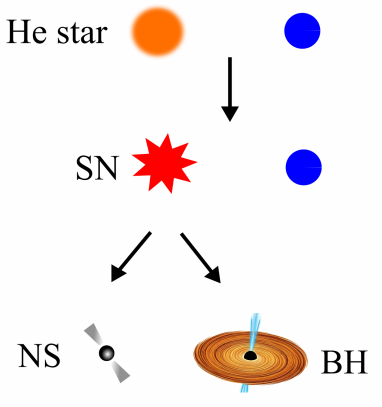
Figure 1. Schematic diagram of the evolution of massive He stars.
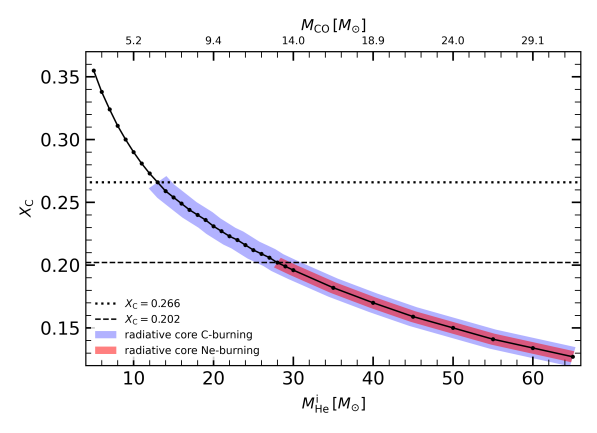
Figure 2. CO core masses and central carbon abundances at central helium exhaustion for He star models with different initial masses. Image by LONG.
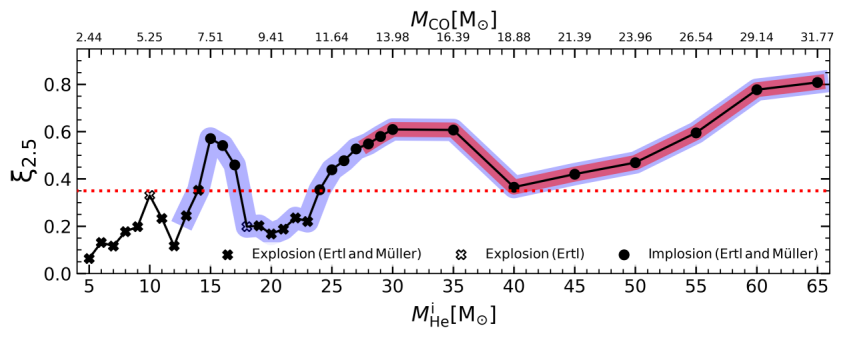
Figure 3. Compactness parameters at core collapse for He star models with different initial masses. Image by LONG.
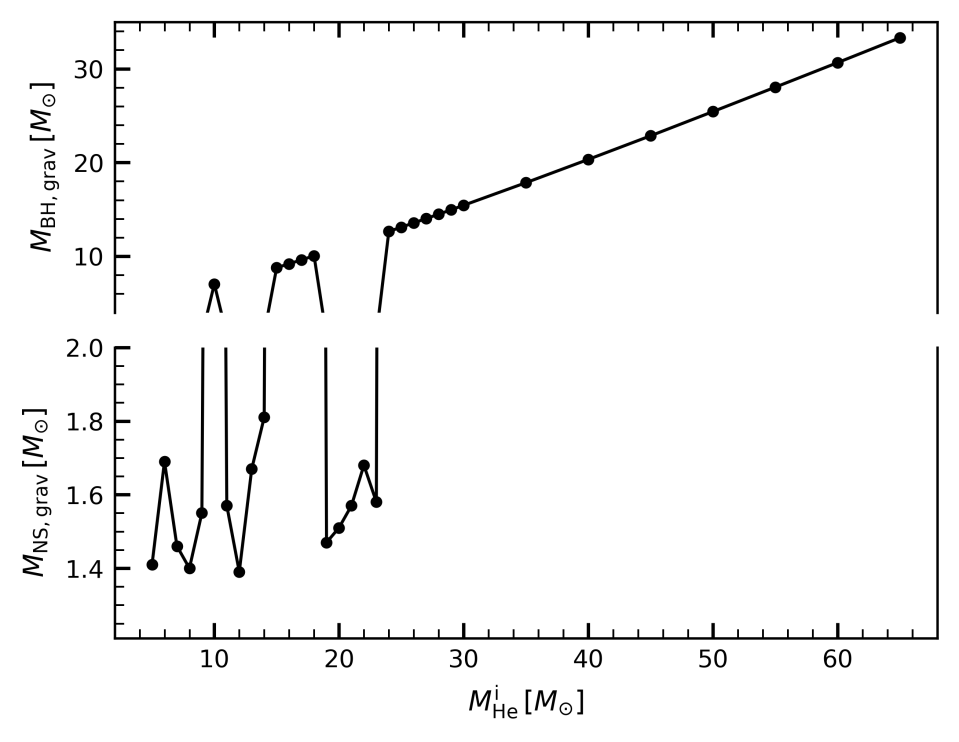
Figure 4. Final fates of He star models with different initial masses. Image by LONG.
Contact:
LONG Gang
Yunnan Observatories, CAS
e-mail:longgang@ynao.ac.cn


