Recently, early-career associate researcher DUAN Yadan from the Yunnan Observatories, Chinese Academy of Sciences, together with collaborators, used high-resolution chromospheric observations from the one-meter New Vacuum Solar Telescope (NVST) to investigate the triggering mechanism of recurrent light bridge jets and the slipping motions of their jet base points (JBPs). The study was published in The Astrophysical Journal Letters.
Light bridge (LB) jets offer a unique window into small-scale eruptive phenomena within sunspots, where the Sun’s magnetic environments are strongest. The magnetic field strength in LBs is approximately 1000 G, significantly weaker than the adjacent umbra’s strength of about 3500 G, and the magnetic field lines in LBs are more horizontal than those in the umbra. These differences create a sharp and strong current layer at the boundary between the horizontal fields of the LBs and the vertical fields of the umbra. As a result ,this boundary may be an ideal site for magnetic reconnection. Previous studies have revealed scarce clues of magnetic reconnection driving some LB jets, but the three-dimensional (3D) characteristics of slipping magnetic reconnection had not been reported.
Using high-resolution observations from the NVST, the researchers investigated six recurrent light bridge jets and the slipping motions of their jet base points (JBPs). The observations show that these LB jets resemble coronal jets in structure: each features a preceding JBP followed by a collimated jet spire. The JBP of each repeated jet along the LB displays apparent slipping motion, and this motion is temporally correlated with quasi-periodic enhanced photospheric horizontal motion. Following the slipping JBPs, the resulting jet spires' fronts display similar slipping behaviors within the upper solar atmosphere. Data from the Chinese Ha Solar Explorer (CHASE) reveal Ellerman-bomb-like spectral signatures at the JBPs, confirming that magnetic reconnection is operating at the jet base.
Based on these results, the research team proposes that repeated 3D reconnection between the horizontal LB field and the ambient vertical umbral field drives these LB jets. This process appears to be driven and/or modulated by quasi-periodic horizontal motion fueled by convective upflows and the transport of magnetic flux along the light bridge.
The study confirms that some LB jets share a reconnection-driven mechanism with coronal jets. It also provides direct observational evidence of slipping reconnection occurring above light bridges. Furthermore, the findings reveal that photospheric horizontal motions can modulate chromospheric reconnection and trigger three-dimensional slipping reconnection.
This research was supported by the Strategic Priority Research Program of the Chinese Academy of Sciences, the National Science Foundation of China, and Yunnan Fundamental Research Projects.
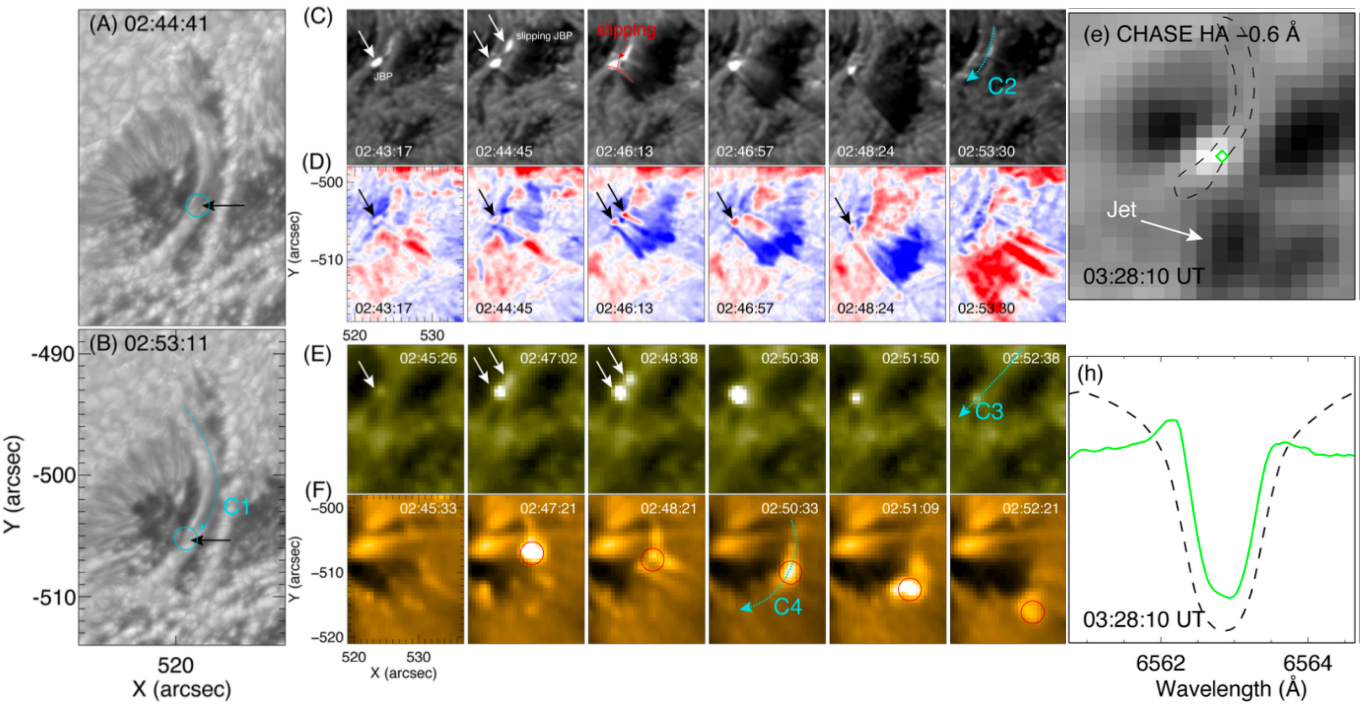
Figure 1. (A-(F) Zoomed-in snapshots showing the evolution of an LB jet from 02:41 UT to 02:50 UT in NVST TiO, Ha -0.6 Å, AIA 1600 Å, 171 Å images and Doppler proxy maps. The black arrows and the cyan circles in panels (A) and (B) denote a horizontal motion front along the light bridge. The white and black arrows in panel (C)-(E) point out the bright footpoints at the base of the LB jet. The red circle marks the bright plasma moving along the leading edge of the LB jet. The green Ha curve at the selected point in panel (h) is marked with a green diamond symbol in (e). Image by DUAN.
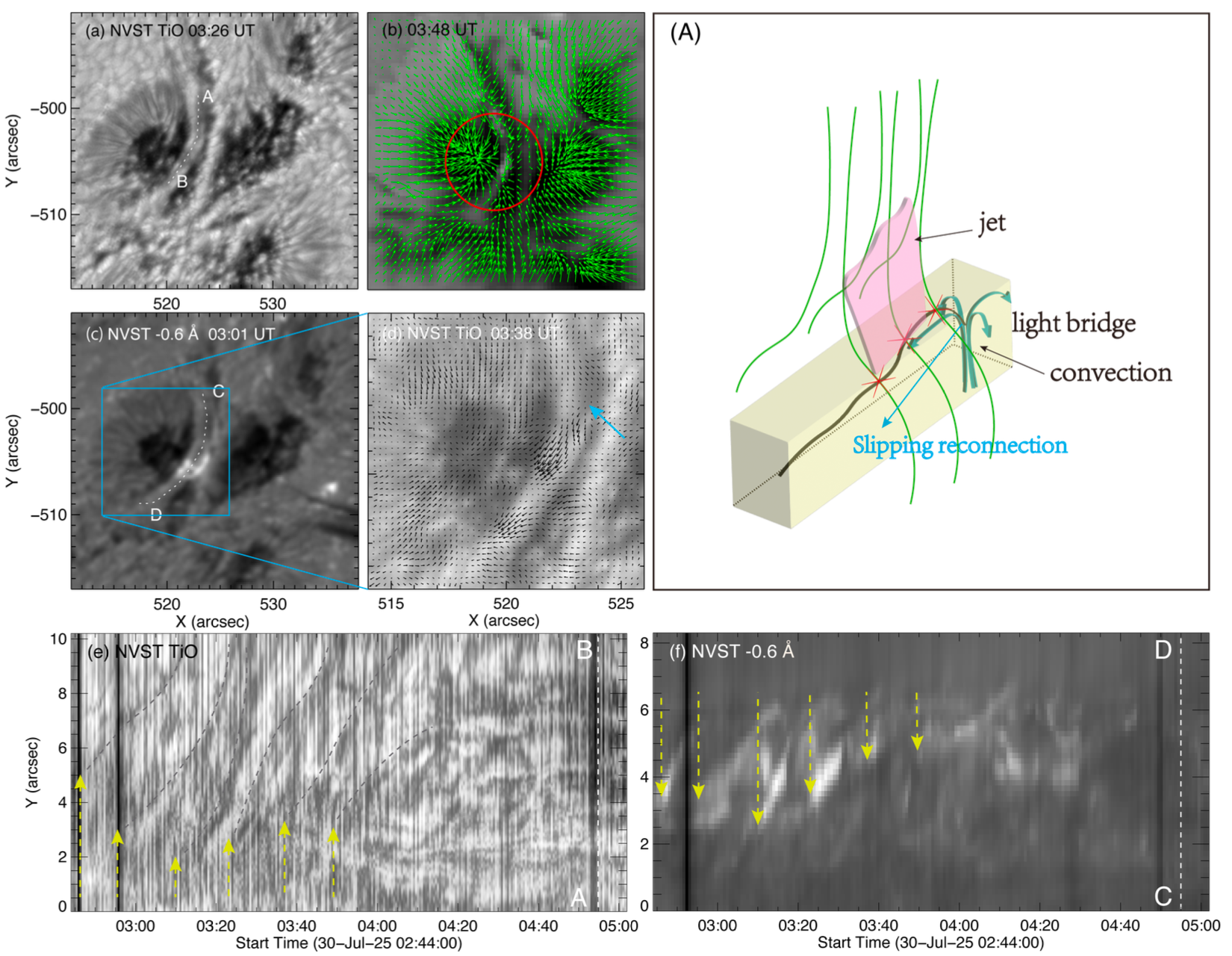
Figure2. (a) NVST TiO image at 03:26 UT. (b) The SDO/HMI vector magnetogram at 03:48 UT. Green arrows represent the strength and direction of the transverse magnetic fields. The boundaries between the sunspot and the LB are highlighted by red circles. (c) NVST Ha off-band at 03:01 UT. (d) The field of view in panel (d) corresponds to the cyan box indicated in panel (c), showing the photospheric flow fields derived via the optical flow method from NVST TiO images. (e)-(f) Time-distance diagrams along the slices AB and CD shown in panels (a) and (b). The yellow arrows point to the six horizontal motions and the JBPs. (A) Schematic depiction of the slipping processes of the LB jet originating from an LB. Image by DUAN.
Contact:
DUAN Yadan
Yunnan Observatories, CAS
e-mail:duanyadan@ynao.ac.cn


