Ph.D. student MENG Fangbin and Prof. ZHU Liying from Yunnan Observatories of the Chinese Academy of Sciences have published a study in The Astrophysical Journal Supplement Series on the evolutionary diversity of solar-type twin binary systems. The study reports that stars with nearly identical masses can exhibit markedly different evolutionary states and magnetic activity levels, providing new observational constraints on stellar evolution.
Twin binaries are systems in which the two stellar components have nearly equal masses. Owing to their highly similar initial conditions, they have long been regarded as ideal laboratories for testing stellar evolution theories. Classical theory predicts that stars of the same mass should follow similar evolutionary paths. The present study, however, reveals that even systems with nearly identical component masses can exhibit significant differences in both evolutionary state and magnetic activity.
The work analyzed four detached eclipsing binaries with G-type spectra: KIC 8957954, KIC 10593759, KIC 8302455, and TIC 207398432. High-precision photometric data from the Kepler mission and the Transiting Exoplanet Survey Satellite (TESS) were combined with spectroscopic observations from the Large Sky Area Multi-Object Fiber Spectroscopic Telescope (LAMOST), the Sloan Digital Sky Survey (SDSS), and ground-based facilities. A joint analysis of light curves and radial velocity curves, together with spectral disentangling techniques yielded accurate determinations of the fundamental stellar parameters, including masses, radii, and effective temperatures.
The results show that, although the mass ratios of the four systems are very close to unity (0.978–0.993), they exhibit significantly different evolutionary stages. Both components of KIC 8957954 and KIC 8302455 remain on the main sequence, whereas KIC 10593759 has evolved to the subgiant stage. In contrast, TIC 207398432 shows a pronounced evolutionary divergence, with its secondary component already evolved into a red giant while the primary remains on the main sequence. Spectroscopic evidence also suggests that this system may belong to a hierarchical triple system.
The study further finds that magnetic activity is closely linked to evolutionary state. The more evolved systems, KIC 10593759 and TIC 207398432, display stronger activity, as indicated by rapid variations in the O’Connell effect. In particular, multiple superflares with energies far exceeding those of typical solar flares were detected in TIC 207398432, providing an important case for investigating extreme magnetic activity in evolved stars.
This work demonstrates that solar-type twin binaries exhibit substantial diversity in both evolutionary status and magnetic activity, offering important observational constraints for refining stellar evolution models.
This work was supported by the Southeast Asia Optical Astronomy International Joint Laboratory of Yunnan Province, the Strategic Priority Research Program of the Chinese Academy of Sciences, key projects of the Yunnan Provincial Science Foundation, and the “Xingdian Talents” Program.
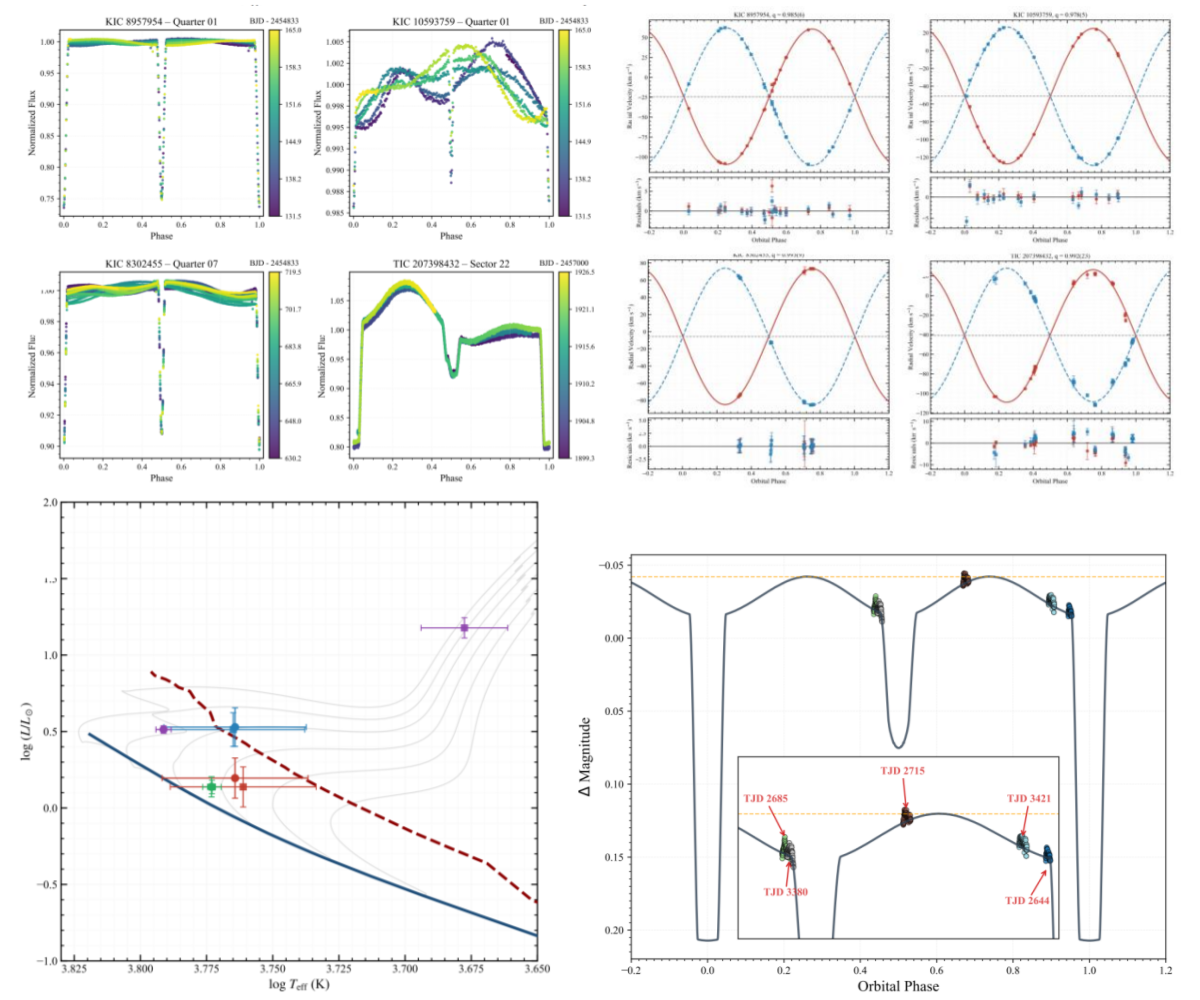
Figure 1. (Top left) Light curves of the four solar-type twin binaries; (top right) radial velocity curves of the four systems; (bottom left) positions of the stellar components in the Hertzsprung–Russell diagram; (bottom right) flare light curve of TIC 207398432. Image by MENG.
Contact:
MENG Fangbin
Yunnan Observatories, CAS
e-mail:mengfangbin@ynao.ac.cn


