Recently, Dr. LI Shasha and Dr. FENG Haicheng of Yunnan Observatories, Chinese Academy of Sciences, and their collaborators, have published an online paper in The Astrophysical Journal. This work improves constraints on the broad-line region (BLR) radius–luminosity (R–L) relation at high luminosities and shows that multi-component BLR structure can bias single-epoch black hole mass estimates.
In Active Galactic Nucleis(AGNs), the BLR is composed of fast-moving, photoionized gas bound to the central supermassive black hole, producing broad emission lines with widths of 103 – 104 km/ s. Reverberation mapping (RM) measures the time delay between continuum and line variability, providing a direct estimate of the characteristic BLR size. Decades of RM campaigns have established the BLR R–L relation, which underpins single-epoch black hole mass estimators and several AGN-based applications.
However, the R–L relation remains poorly constrained at the high-luminosity end because RM monitoring of luminous AGNs is observationally expensive. Moreover, high-accretion-rate AGNs often show lags shorter than R–L predictions, and the roles of intrinsic scatter and BLR structural complexity are still not well quantified.
E1821+643, currently the most luminous AGN with an Hβ RM measurement, is therefore a key target for anchoring the R–L relation and probing these effects. To this end, the team carried out a four-year RM monitoring campaign of E1821+643 using the 2.4 m telescope at Lijiang Astronomical Observatory.
The results show that the Hβ lag in E1821+643 is only 83.2 days, less than one-fifth of the value predicted by the R–L relation. Spectral fitting indicates that, in addition to a normal broad-line component, the Hβ profile includes a significantly redshifted component.
The researchers found that the lag of the normal Hβ component is closer to the value predicted by the R–L relation, whereas the redshifted component has an extremely short lag and originates from a region with a characteristic scale comparable to that of the accretion-disk continuum-emitting region. As a result, the overall Hβ lag is substantially “pulled down” by this redshifted component. Moreover, this redshifted component may affect the interpretation of the intrinsic BLR kinematics, thereby further increasing the uncertainty in black hole mass measurements.
By establishing empirical boundaries for the R-L relation over the full luminosity range, this work clarifies the physical connection between extremely short lags and multi-component BLR structure, and quantifies the potentially large systematic biases such structure can introduce into black hole mass estimates. These results provide important observational support for improving single-epoch mass estimators, refining AGN physical models, and strengthening related cosmological applications.
Intriguingly, the study also finds that, across the full luminosity range, the shortest lags measured from RM observations appear to cluster around 0.2 times (i.e., about one-fifth of) the R–L prediction, suggesting a possible lower boundary of the R-L relation. Further analysis indicates that the upper boundary of the R–L relation may exceed the predicted values by a factor of 2, implying that the effective scatter could be as large as an order of magnitude in extreme cases.
Combined with the potential impact of a multi-component BLR on kinematic inferences, single-epoch black hole mass estimates that assume a single, homogeneous BLR may suffer systematic biases of up to factors of several tens, far exceeding commonly adopted uncertainty levels.
These results advance the understanding of BLR structure and the R–L relation, providing crucial observational evidence for more accurate measurements of supermassive black hole masses and for building more realistic physical models of AGNs. In the future, the team will conduct high-precision RM observations of a larger AGN sample to test how common multi-component BLR structures are and, on this basis, further refine physical models and optimize black hole mass measurement methods, thereby providing more robust observational support for studies of galaxy-black hole co-evolution and cosmology.
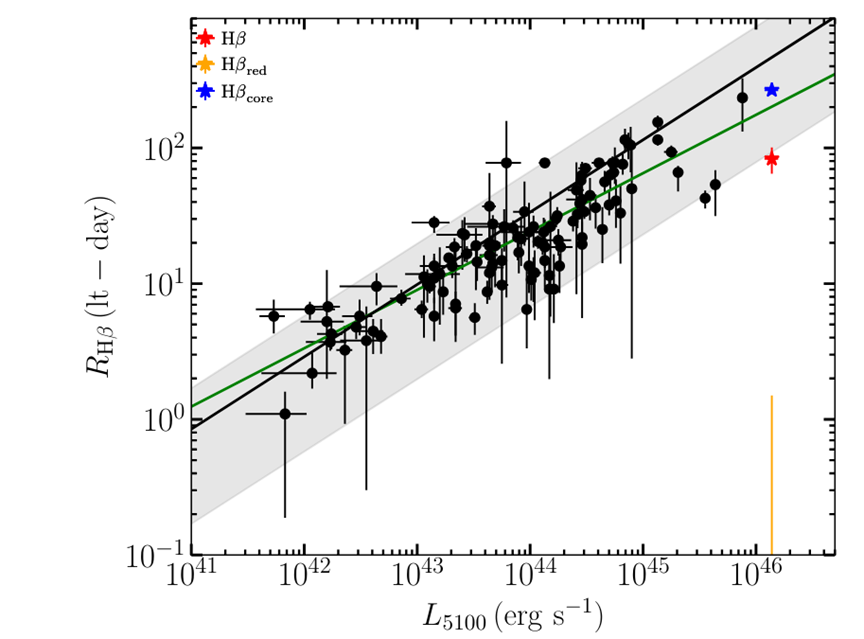
Figure 1. R-L relation. The black line shows the best-fit relation from M. C. Bentz et al. (2013), while the shaded region marks the range between 0.2 and 2 times the radius predicted by this relation. Circles represent data points from the sample of S. Wang & J.-H. Woo (2024), and the green line denotes their best-fit result. Colored stars show our measurements for E1821+643: the red star corresponds to the result from the total Hβ profile, the orange star to the redshifted component, and the blue star to the normal component. Image by LI.
Contact:
LI Shasha
Yunnan Observatories, CAS
e-mail:lishasha@ynao.ac.cn


