Recently, a research team led by FENG Yezheng, a jointly trained graduate student of the Stellar Physics Research Group at Yunnan Observatories, Chinese Academy of Sciences and the Institute of Theoretical Physics, Shanxi University, has developed a new method for searching for solar-like oscillations and applied it to southern sky targets observed with a 2-minute cadence by the Transiting Exoplanet Survey Satellite (TESS). The results were published in The Astrophysical Journal Supplement Series.
Solar-like oscillations constitute the most numerous and widely distributed class of oscillating stars in the asteroseismic Hertzsprung–Russell diagram and can be detected in stars with outer convective envelopes. The detection of solar-like oscillations provides important observational constraints on stellar structure and evolution theories, as well as on Galactic archaeology. In the past, the number of stars with detected solar-like oscillations was limited due to observational constraints. The launch of TESS has made it possible to search for solar-like oscillators across nearly the entire sky. It is expected that TESS will observe about 500000 solar-like oscillators; however, the number currently detected remains far below this prediction. Previous studies have shown that, in the frequency spectra observed by TESS, only a small fraction of known solar-like oscillators exhibit a clearly measurable large frequency separation. This suggests that detection methods based on regularly repeating frequency patterns may miss targets with weaker oscillation signals or less clearly defined oscillation modes.
To address this issue, the study adopted a detection strategy that does not rely on measuring the large frequency separation. Instead, the presence of an excess power envelope in the power spectrum is used as the main indicator for identifying solar-like oscillations, combined with manual verification. This approach partially compensates for the limitations of traditional identification strategies based on frequency spacing and increases the number of detectable solar-like oscillation signals in large TESS datasets.
First, the research team fitted the power spectra of previously known solar-like oscillators to characterize the envelope features of solar-like oscillations in the frequency spectrum. Based on these characteristics, an automated program was developed to identify structures in stellar power spectra consistent with these envelope features. Tests show that the program achieves a detection rate of 91.5% with a false-positive rate of 2.7%. Finally, visual inspection was performed to confirm the oscillations. Among the 220000 stars observed by TESS in its first and third years with a 2-minute cadence, the automated procedure flagged 16800 stars as candidates, and visual inspection ultimately confirmed 10548 solar-like oscillators.
Based on this sample, the research team used a segmented autocorrelation technique to measure two global asteroseismic parameters—the frequency of maximum oscillation power and the large frequency separation—and estimated their uncertainties via Monte Carlo simulations based on chi-square perturbations. In addition, the study proposed a new criterion to evaluate the reliability of large frequency separation measurements. As a result, measurements of the frequency of maximum oscillation power were obtained for all detected solar-like oscillators, while the large frequency separation was measured for 4775 of them.
Compared with previous studies, this work identified the largest number of oscillating stars within the sample of 220000 targets. Among the 10548 solar-like oscillators identified in this study, 2972 stars are newly discovered oscillators. About half of these oscillators have large frequency separations smaller than 20 μHz. Among the 4775 stars with measured large frequency separations, 1920 have their large frequency separations reported for the first time.
This study provides a new technical approach for efficiently identifying solar-like oscillations in large-scale space-based observational datasets. The method shows particular advantages when dealing with data of lower observational quality or less clearly detectable oscillation signals. In future sky survey projects, this approach can be used to perform preliminary screening of targets using the first one to two months of observational data, helping to identify high-value targets for subsequent long-term observations and significantly improving the scientific output of survey missions.
This work was supported by the National Natural Science Foundation of China , and the National Key Research and Development Program.
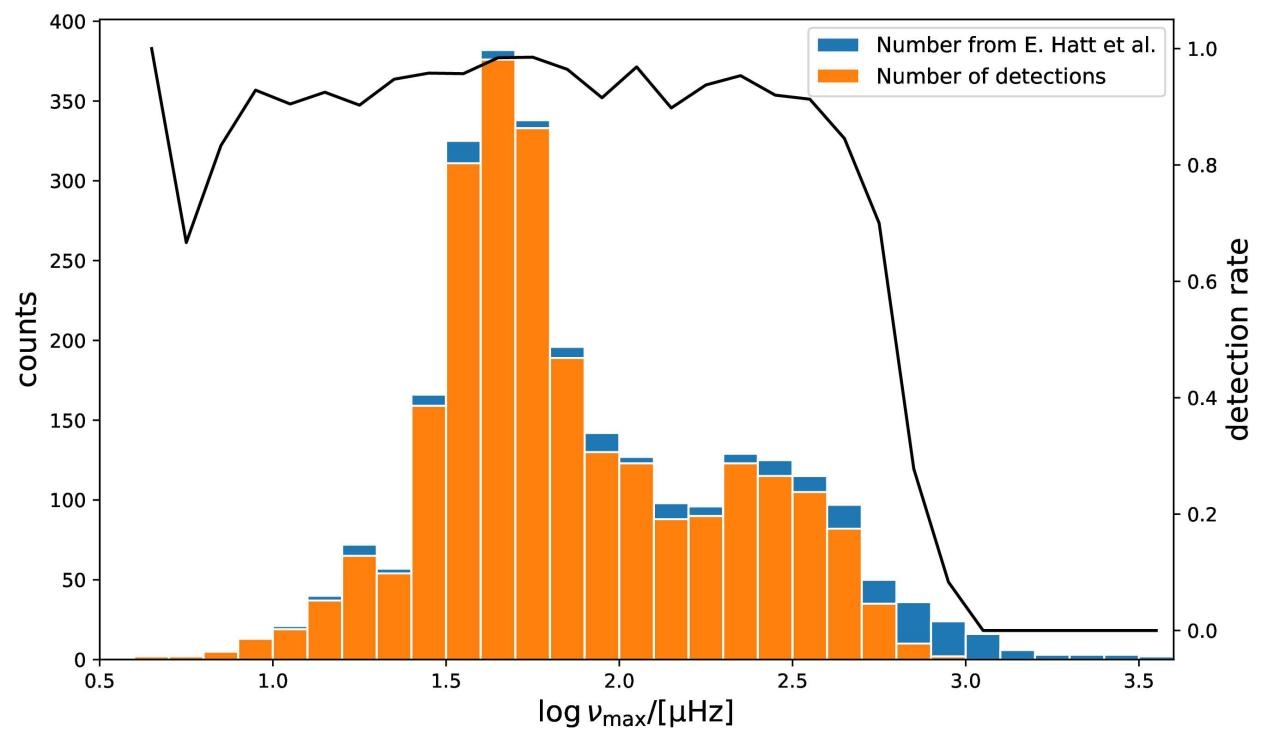
Figure 1:Detection rate of solar-like oscillators obtained with the automated procedure. The blue histogram shows the distribution of oscillators identified by E. Hatt et al. (2023) as a function of the frequency of maximum oscillation power. The orange histogram shows the number detected by the procedure within the same sample, and the black curve represents the corresponding detection rate. Image by FENG.
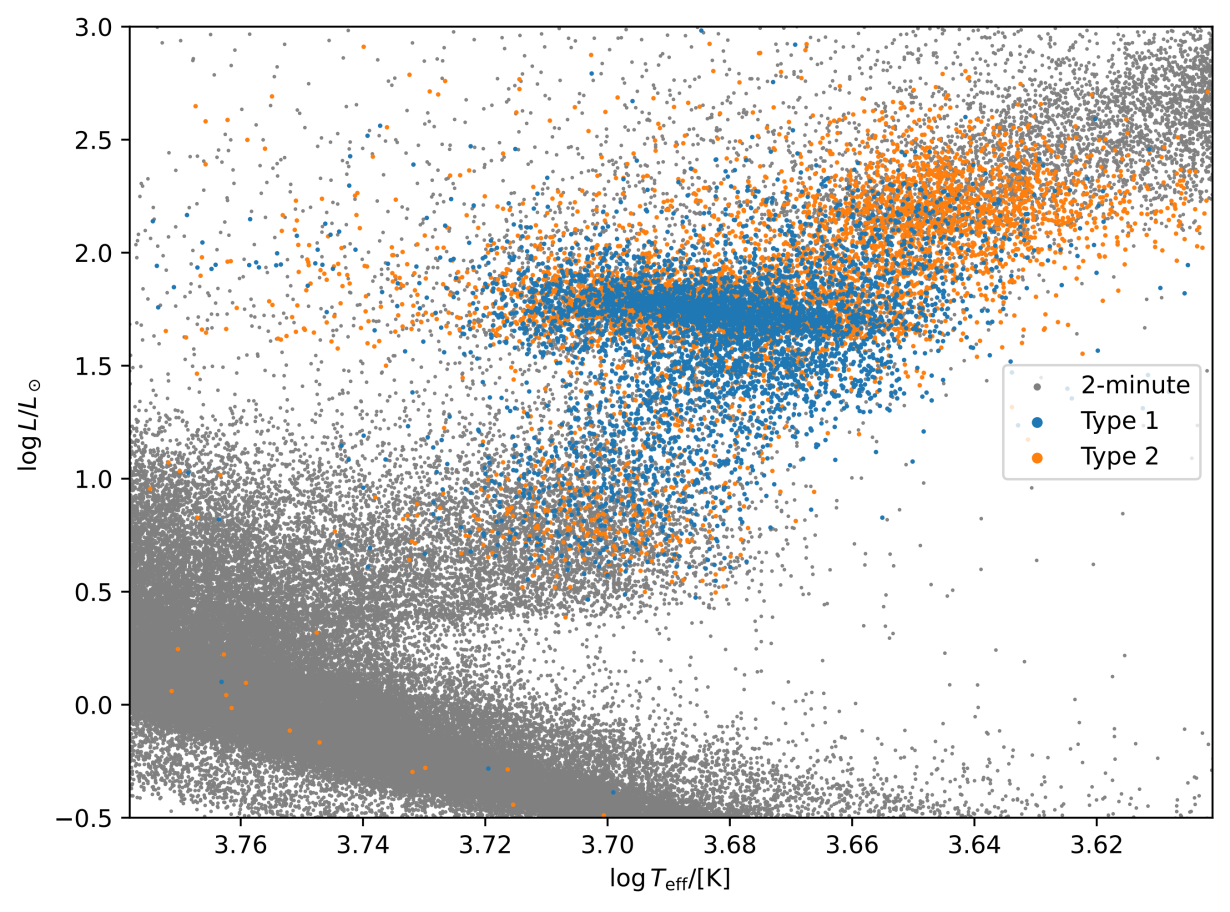
Figure 2: Distribution of the detected solar-like oscillators in the H–R diagram. Blue and orange points denote oscillating stars with and without measured large frequency separations, respectively, while gray points indicate stars in the full sample. Image by FENG.
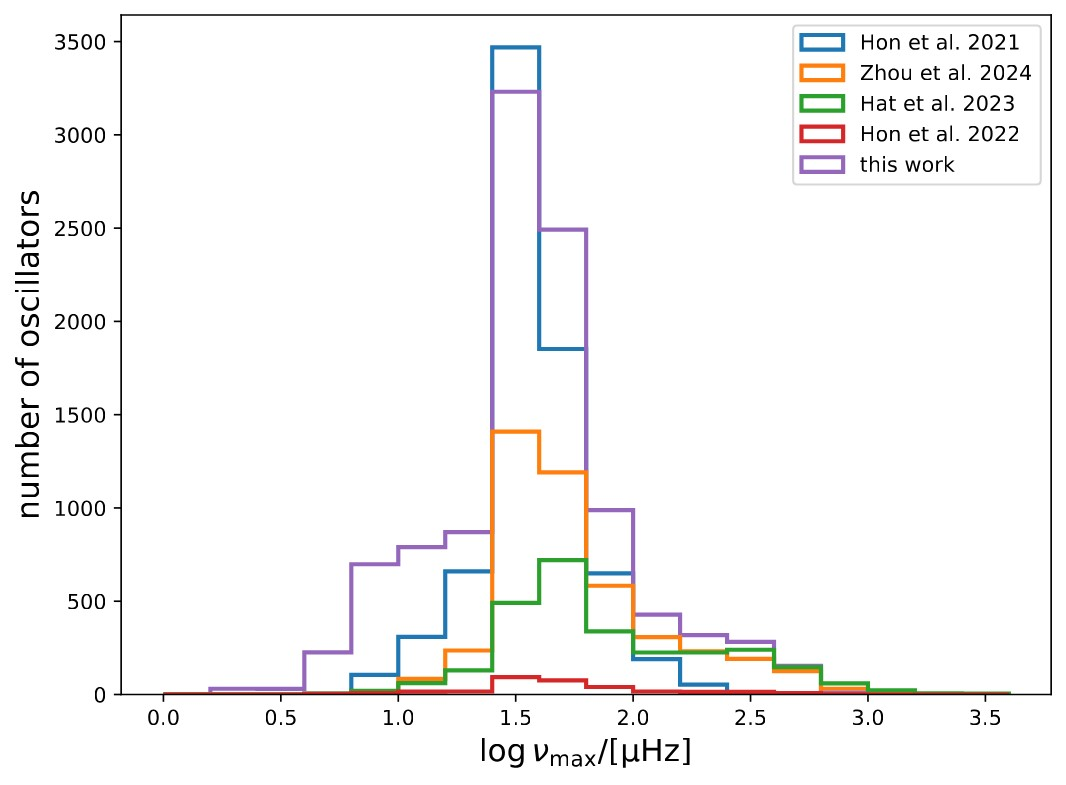
Figure 3: Number of oscillating stars detected by different studies in the sample of 220,000 stars. Image by FENG.


