Recently, Dr. FENG Haicheng from Yunnan Observatories, Chinese Academy of Sciences, and his collaborators reported a nonmonotonic relationship between the continuum lag and luminosity in changing-look (CL) active galactic nuclei (AGNs). The work has been published in The Astrophysical Journal.
AGNs are among the brightest sources in the universe, powered by gas accretion onto supermassive black holes (SMBHs). The structure of the accretion disk is believed to depend on the accretion rate, linking AGN variability closely to SMBH growth and feedback. However, typical AGN evolution occurs over timescales of 100,000 years, far longer than the span of human observation. The discovery of CL AGNs, which show rapid accretion rate changes along with the emergence or disappearance of broad emission lines, provides a unique window into accretion disk transitions.
Continuum reverberation mapping (RM) is a key tool for measuring accretion disk size by tracking wavelength-dependent time lags in light curves. However, observed lags often exceed the predictions of the standard thin-disk (SSD) model. This discrepancy may arise from diffuse continuum (DC) emission in the broad-line region or from limitations in current models. Most previous RM studies relying on broadband photometry are limited to a single luminosity state, making it difficult to assess disk evolution or isolate DC contamination.
To address these challenges, the team has conducted a long-term spectroscopic campaign of the CL AGN NGC 4151 using the Lijiang 2.4-meter telescope since 2020. They obtained high-quality, pure continuum light curves covering a broad wavelength range from 369 to 937 nm. This is the second AGN for which spectroscopic continuum RM has been achieved, and the first such measurement from ground-based telescopes. In 2024, the project was further extended in coordination with the Swift Space Telescope, providing full coverage from the ultraviolet (192.8 nm) to the near-infrared.
Their analysis shows that time lags are 6.6 times longer than those predicted by the SSD model. Thanks to the advantages of spectroscopic data, the team found clear signatures of DC contamination in the lag spectrum, including a significant dip in time lags around the Balmer and Paschen jump regions.
Notably, the lag does not increase monotonically with brightness: it first rises, then falls at higher luminosities. This non-monotonic behavior is statistically significant, deviates from SSD model predictions, and cannot be attributed to DC contamination alone. The team suggests that it may reflect an intrinsic Baldwin effect within the DC, where the DC contribution weakens relative to intrinsic emission at higher luminosities, thus shortening the observed lag.
The findings provide crucial evidence for building more refined theoretical models and raise new questions about the accuracy of SMBH mass measurements.
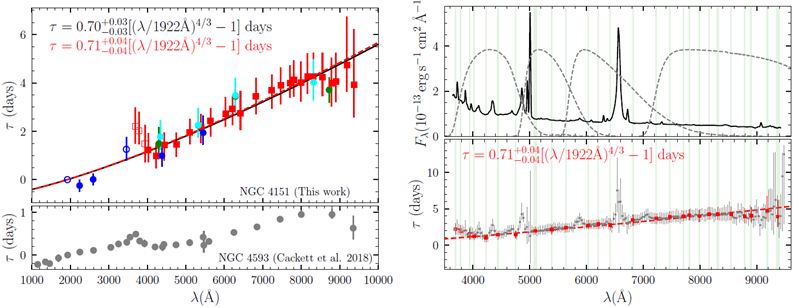
Figure 1. Wavelength-dependent lags. Left: the top panel shows lags for NGC 4151 derived from Swift photometry (blue dots), Lijiang photometry (green dots), synthetic photometry (cyan dots), and spectroscopy (red squares). The black solid line and red dashed line represent the best-fit lag, using all data points and spectroscopy-only data, respectively. Hollow points were excluded from the fits. The bottom panel shows spectroscopic continuum lags of NGC 4593 from Hubble Space Telescope observations. Right: the mean spectrum with Lijiang filter transmission curves (top) and the lags measured at different wavelengths (bottom). The spectrum and transmission have been corrected to the rest frame. Gray dots indicate lags measured from the spectrum at every 3 nm, while the red squares and red dashed line are the same as those in the left panel. The green shaded regions mark the line-free wavelength ranges chosen for the analysis. Image by FENG.
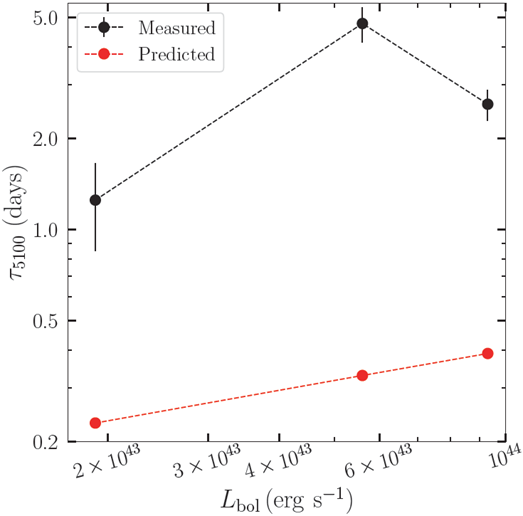
Figure 2. Lag versus luminosity for three campaigns. Black and red represent the measured time delays and the predictions from X-ray reprocessing in a standard thin accretion disk model, respectively. Image by FENG.
Contact:
FENG Haicheng
Yunnan Observatories, CAS
e-mail:hcfeng@ynao.ac.cn


