A study of the temporal evolution of the afterglow of gamma ray burst GRB 240825A has been published in The Astrophysical Journal. The research, led by Phd student LI Ruizhi and Mao Jirong from the Yunnan Observatories of the Chinese Academy of Sciences provides new evidence for understanding the physical environment surrounding gamma ray bursts and offers important insights into the mechanisms governing their afterglow emission.
Long-duration gamma-ray bursts (LGRBs) are widely believed to originate from the core collapse of massive stars and typically occur in dense star-forming regions. The Swift satellite detected GRB 240825A on August 25, 2024, noting an unusually bright optical counterpart. Early data showed an X-ray afterglow spectral index of 0.79 and a significantly softer optical afterglow spectral index of 2.48, compared to a typical value of around 1. According to standard models, a gamma-ray burst is classified as "optically dark" when its observed optical afterglow flux falls below the expectation based on the X-ray spectral index.
The team conducted follow-up observations of the afterglow of GRB 240825A using both space- and ground-based facilities, including the Lijiang 2.4-meter telescope, and performed a systematic analysis of its optical darkness by combining multiwavelength afterglow data. They quantified the optical darkness using the spectral index from the optical to X-ray bands (βₒₓ). The results revealed a clear temporal evolution: the optical darkness initially decreased, reached a minimum around 1000 seconds after the burst—meeting the criterion for an optically dark gamma-ray burst—and then increased. By approximately 11 hours after the burst, the afterglow no longer satisfied the definition of an optically dark event, marking a distinct transition to an optically bright phase.
Further analysis of the spectral energy distribution (SED) of the afterglow of GRB 240825A in optical and X-ray bands indicated that the extinction in its surrounding medium gradually decreased over time. This suggests GRB 240825A likely originated in a dense circumburst environment.
The findings provides new observational clues for understanding the origins of optically dark gamma-ray bursts and the evolution of their surrounding environments.
This work is supported by the National Key R&D Program of China, the Natural Science Foundation of China, and the Yunnan Revitalization Talent Support Program.
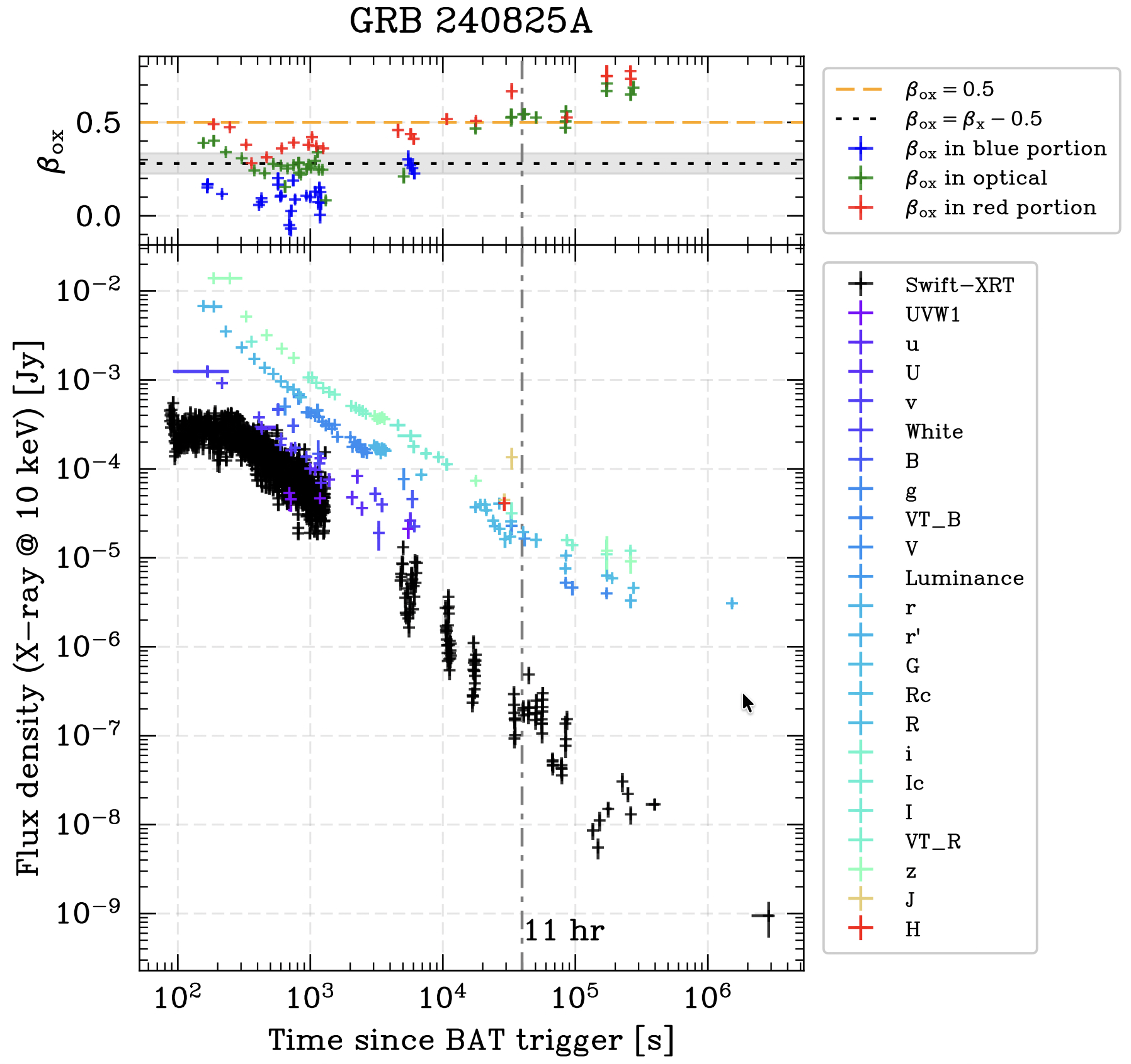
Figure 1, multiwavelength light curves of the afterglow of GRB 240825A. Image by LI.
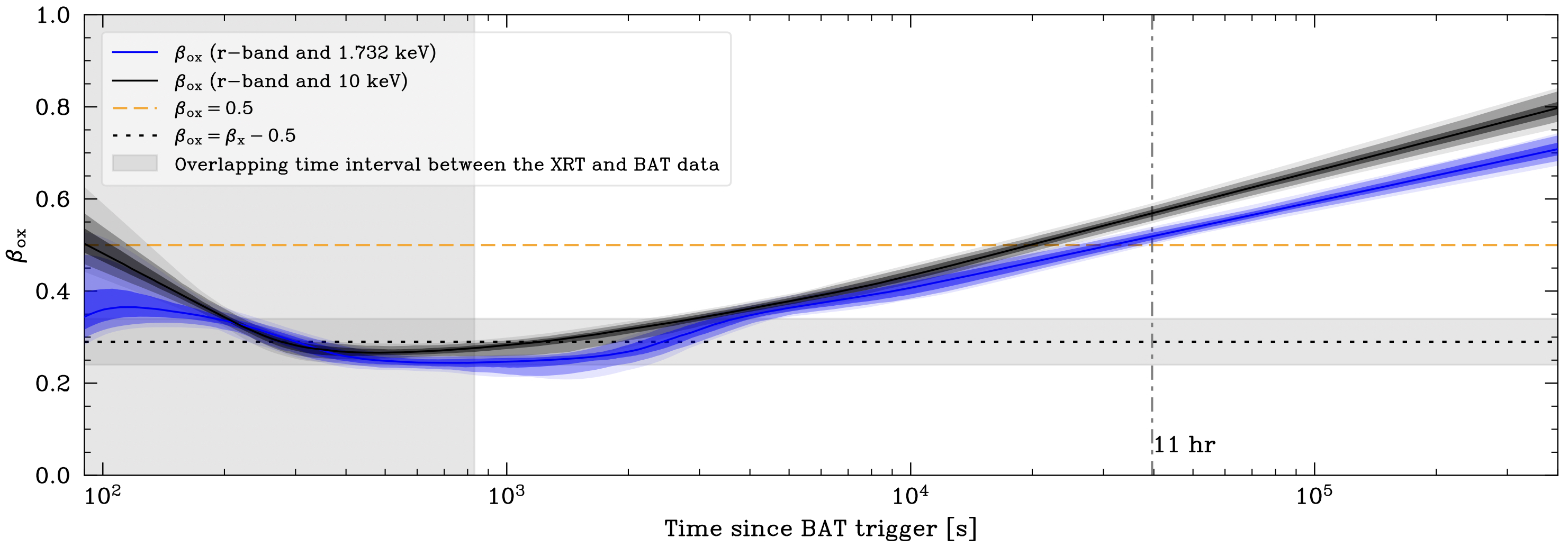
Figure 2, time evolution of optical darkness in the afterglow of GRB 240825A. Image by LI.
Contact:
MAO Jirong
Yunnan Observatories, CAS
e-mail:jirongmao@ynao.ac.cn


